
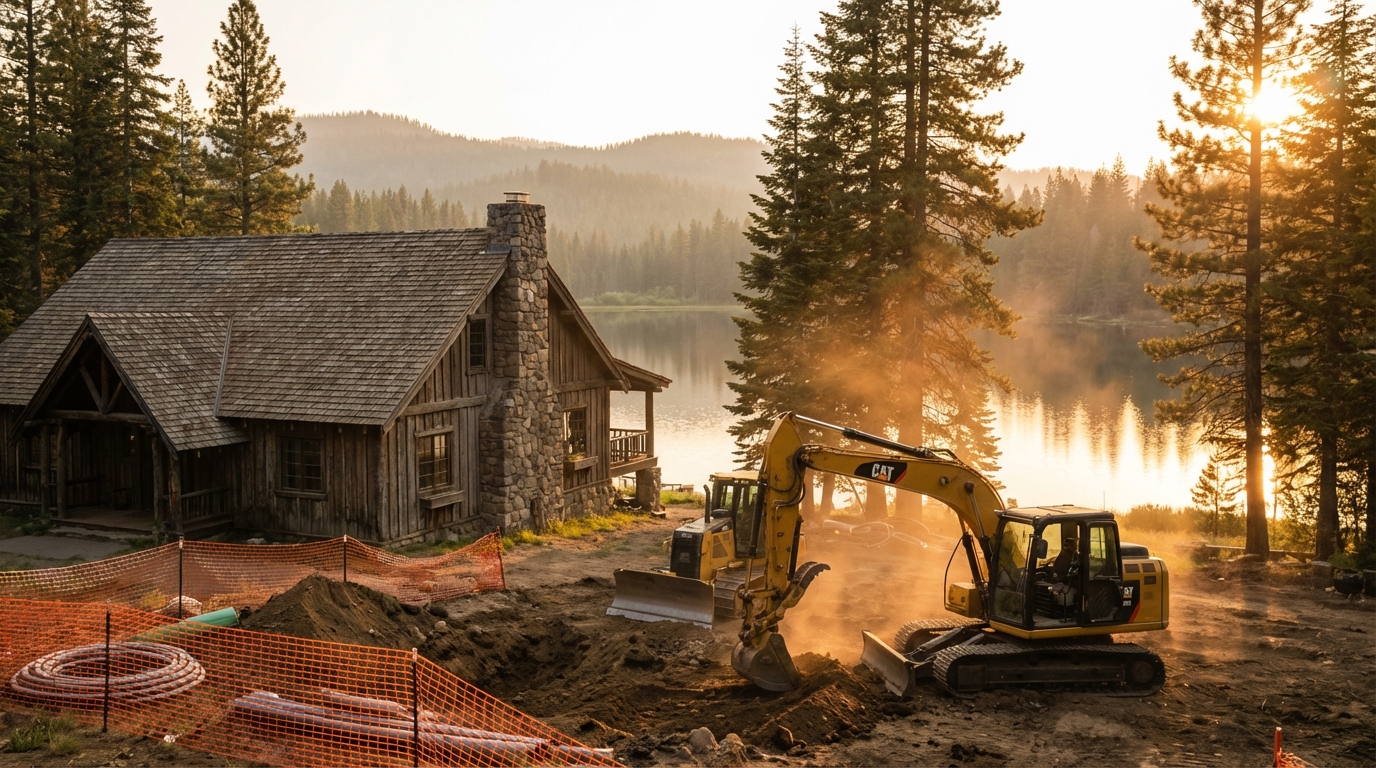

The Flathead National Forest released a formal proposal on March 2 to reconstruct the failing wastewater treatment system at Holland Lake Lodge, a century-old Swan Valley resort that has remained closed since 2023 after infrastructure failure forced the historic property to miss its centennial season and shutter through 2025, according to the Flathead Beacon. The project would replace aging lagoon liners with a modernized system capable of serving the lodge, the adjacent 44-site campground, and an RV dump station that together form a critical access point to public lands near the Bob Marshall Wilderness.
The original wastewater system, constructed in 2000, went offline approximately 23 years into its service life due to deteriorating lagoon liners. New owners Eric Jacobsen and Thomas Knowles, operating as Holland Peak, LLC, acquired the property in October 2023 from longtime owner Christian Wohlfeil and secured a 20-year special-use permit to operate the lodge in its existing footprint. Despite the ownership transition, the property could not reopen due to the wastewater deficiencies. Forest Supervisor Anthony Botello emphasized the urgency of the project, stating, “The need for this project is to replace and modernize the wastewater treatment system which would restore a valued resource for the community, a driver for the local economy, and improvement of visitor access to the surrounding National Forest System lands — all desired conditions identified in the Flathead National Forest Plan. System replacement is necessary to allow the Holland Lake Lodge to continue providing lodging and food services as well as providing a wastewater treatment system for the campground loop, host sites, and RVs.”
The Holland Lake situation offers broader lessons for the outdoor hospitality industry. For campground and RV park operators, this case illustrates consequences that can unfold when wastewater infrastructure fails unexpectedly. Lagoon-based treatment systems typically require liner replacement or major rehabilitation every 15 to 25 years depending on environmental conditions, usage volume, and maintenance practices. The Holland Lake system was approximately 23 years old when it failed, falling squarely within this expected lifecycle range. Operators can protect themselves by conducting annual inspections of lagoon liners, pump stations, and distribution systems to identify deterioration before it becomes critical. Establishing dedicated capital reserve funds for infrastructure replacement allows operators to plan financially for inevitable system upgrades rather than facing emergency situations that force extended closures.
While awaiting permanent infrastructure, the lodge secured a variance from the Missoula County Board of Health earlier this year to use a temporary holding tank as a stopgap wastewater solution, with backup chemical toilets also permitted. The variance allows the lodge to host special events and limited operations and expires Dec. 31, 2028, or when the permanent lagoons are operational, whichever comes first. Meanwhile, the Forest Service has serviced the campground with portable toilets since 2024 and will continue that approach this year. Botello acknowledged the limitations of the temporary arrangement, saying simply, “We know it’s not ideal, but it’s only temporary.”
The lodge’s reliance on holding tanks and portable facilities highlights a challenge many operators face during infrastructure transitions. When permanent wastewater systems require major rehabilitation, outdoor hospitality operators face challenges maintaining service quality while relying on temporary solutions. Modern portable restroom trailers with flushable toilets, running water, and climate control provide significantly elevated experiences compared to traditional portable units. Clear communication with guests before arrival about temporary conditions allows informed booking decisions and often generates goodwill when expectations are properly set. For RV operations specifically, partnering with nearby facilities offering dump station access can maintain service for self-contained RV guests during infrastructure outages. Many operators have found that transparent communication about infrastructure improvements actually resonates positively with environmentally conscious guests who appreciate investments in modern, eco-friendly systems.
The proposed system is designed to accommodate the same level of use as the previous facility, serving the 44-site campground, RV dump station, and lodge. The lodge is permitted to accommodate up to 54 guests and 12 employees, while its restaurant serves 250 meals per day to the public. Estimated annual wastewater flow of 1,237,250 gallons, based on 101 days of campground operation and year-round lodge operations, falls below both the design capacity of existing lagoons and the permitted use of 1,693,000 gallons per year. The increase in lagoon size results from an updated water balance analysis accounting for all inflows and outflows. While the lodge historically operated Memorial Day to Labor Day, the new owners intend to operate year-round under their permit terms.
Botello framed the project within the Forest Service’s broader mission, stating, “We have an obligation and a mission to provide and deliver recreation on National Forest System lands. We believe in that wholeheartedly and that includes the Holland Lake campground the RV dump station and the lodge. The people who visit need a functioning system and that’s what we are trying to provide — a system that supports public use of public lands in an environmentally sustainable way and that is what we are intending in this design. But we need a way to treat the wastewater.”
The project is classified under a categorical exclusion for environmental review under the National Environmental Policy Act, a less intensive tier of analysis than an environmental assessment or environmental impact statement that is typically used for routine maintenance or reconstruction of existing facilities. Despite the streamlined classification, the project will still undergo environmental review. The design is being developed by a private engineering firm in consultation with the Montana Department of Environmental Quality. A public comment period is now open, and a community meeting is scheduled for March 9 at the Swan Valley Community Hall in Condon from 5:30 p.m. to 7:30 p.m.
Botello emphasized his commitment to public engagement, stating, “We’re very interested in making sure this proposal receives some level of buy-in from the public, and that includes reassuring them that we’ve done our due diligence insuring that this facility protects the natural resources we all care about. Folks have a keen interest in Holland Lake Lodge. I know why they are interested in it, and I’m glad they are interested in it. And we plan to engage the public so that they understand what we’re proposing right down to the most technical aspects of the project.” He added that transparency has guided the process: “We finalized the proposal and I published it to our website the next day. We are truly sharing information as we get it.” The supervisor confirmed he will accept public input “right up until and including the moment I make a final decision.”
If approved, construction could begin as early as summer 2026 and continue through summer 2027. “It will likely be a two-season construction timeline,” Botello said. “We’ll be super pleasantly surprised if it takes less time than that.”
That projected timeline means Holland Lake Lodge’s journey from system failure to full restoration could span from 2023 through 2027—a multi-year disruption that underscores why proactive infrastructure management matters for outdoor hospitality operators. Maintaining detailed records of system performance, maintenance activities, and capacity utilization provides valuable data for predicting replacement timelines. Building relationships with local health departments and environmental regulators ensures operators stay informed about changing compliance requirements before problems arise. Many successful campground operators now incorporate infrastructure lifecycle assessments into long-term business planning, treating major system components as depreciating assets requiring scheduled replacement.
Holland Lake Lodge’s path to this moment has been marked by public scrutiny. In 2022, a high-profile expansion proposal generated controversy, and discrepancies in the prospective buyer’s permit application combined with shortcomings in its review led the Flathead National Forest to reject that plan. The current owners took a different approach with a smaller-scale vision that tempered public concerns, though wastewater infrastructure has remained the primary obstacle to reopening. With a formal proposal now before the public, the lodge’s future hinges on whether the reconstruction can proceed on schedule to restore this valued community resource.
