
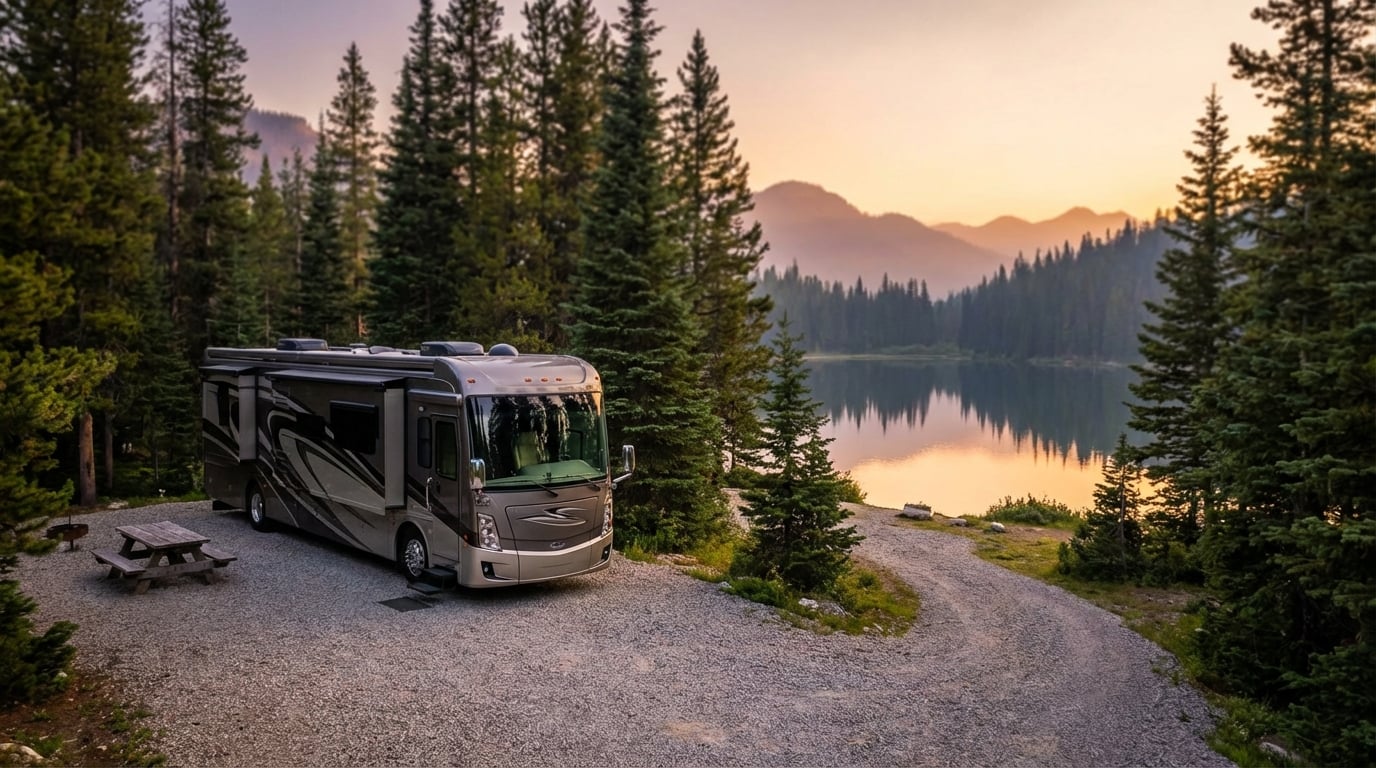

The Flathead National Forest has unveiled a comprehensive improvement project at Lindbergh Lake Campground that will address aging infrastructure dating back more than five decades, with construction spanning two summer seasons beginning in 2026. Located approximately nine miles south of Condon, Montana, the campground will receive upgrades designed to meet current design standards and improve accessibility without expanding overnight capacity. The project responds to longstanding challenges at the site, where narrow campsites and access roads have made navigation increasingly difficult for larger recreational vehicles that have become commonplace among today’s travelers.
The day-use recreation site and lower campground loop were originally constructed in 1968, while the upper campground loop was added in 2003. This timeline places the facility squarely within an era when recreational vehicles were substantially smaller than the units dominating roads today. Swan Lake District Ranger Sarah Canepa addressed the project’s goals in the project announcement: “The Flathead National Forest is proposing these improvements to the Lindbergh Lake Campground to provide quality recreation experiences while protecting resources. This project is not expanding the capacity of the campground or day use site but seeks to accommodate the existing use that is occurring at Lindbergh Lake.”
For campground and RV park operators watching federal investment priorities, this project signals an important shift in baseline expectations. Modern Class A motorhomes commonly exceed 40 feet in length, and travel trailers equipped with slide-outs require wider site footprints than models manufactured in previous decades. Fifth-wheel units frequently demand pull-through sites with turning radiuses that layouts from the 1960s through early 2000s simply cannot accommodate. Pull-through sites generally should measure 70 to 80 feet in length and 25 to 30 feet in width to serve most modern RVs with slide-outs deployed. Interior campground roads typically require a minimum of 12 to 14 feet for one-way traffic and 20 to 24 feet for two-way traffic to allow safe passage of larger units, while intersections and loop turnarounds should incorporate turning radiuses of at least 50 feet.
Private operators with infrastructure of similar vintage to Lindbergh Lake should evaluate whether current layouts can adequately serve the vehicles guests are purchasing today. The federal government’s willingness to invest in upgrading a facility to accommodate existing demand suggests that serving modern RV dimensions has become a baseline standard rather than a premium amenity.
The planned upgrades encompass multiple elements across the recreation site. The Forest Service will replace the existing boat ramp, improve day-use parking with additional trailer parking spaces, and install a second vault toilet to service the upper campground loop. A designated trail connecting the upper and lower loops will also be constructed, along with additional amenities throughout the site. Operators seeking technical specifications can review the complete project documentation through the Forest Service planning portal.
One particularly noteworthy element involves the new connecting trail between the upper and lower loops, which is specifically intended to reduce informal social trails that have developed along the lakeshore. This approach demonstrates a proactive environmental management strategy that private operators can replicate at their own properties. Informal or social trails created by foot traffic represent one of the most common and preventable forms of environmental degradation at campgrounds and RV parks located near natural features. When guests create their own paths to access water features, scenic overlooks, or neighboring sites, the resulting erosion, vegetation loss, and habitat fragmentation can diminish the very natural appeal that attracts visitors in the first place.
Operators with waterfront or forest settings should consider auditing their properties for areas where informal paths have developed. Installing clearly marked trails with natural borders such as logs, rocks, or native plantings guides foot traffic and discourages shortcutting. Strategic placement of fire rings, picnic tables, and seating areas can orient guests toward designated paths, reducing the impulse to create informal routes. Permeable materials like crushed gravel or boardwalks protect sensitive ground cover in high-traffic areas while maintaining natural aesthetics. Simple interpretive signage explaining the ecological importance of staying on designated trails often improves compliance without creating a restrictive atmosphere, and vegetated buffers between campsites and sensitive areas like lakeshores provide natural barriers while preserving scenic views.
The project is funded through the Great American Outdoors Act, with construction activities slated to begin during summer 2026. The Forest Service estimates the work will require two summer seasons to complete, during which visitors may experience brief access disruptions to both the campground and the boat launch. This phased approach offers a practical model for private operators considering similar infrastructure investments. Spreading upgrades across multiple seasons helps minimize revenue loss while achieving necessary improvements, allowing facilities to remain at least partially operational during construction periods.
The Forest Service is accepting public comments on the proposal, with feedback most helpful if submitted by March 31, 2026. Interested parties can access the proposed action document through the agency’s public file system to review specific project details before providing input.
The Lindbergh Lake project illustrates how infrastructure investments in seemingly simple amenities can address multiple objectives simultaneously. The designated connecting trail reduces environmental impact while improving accessibility and enhancing overall recreation quality. For private campground operators, particularly those managing properties with waterfront or forest settings, this federal initiative provides a practical case study in upgrading legacy infrastructure to serve contemporary visitors.
The outdoor hospitality industry continues to grapple with the tension between preserving natural character and accommodating evolving guest expectations. Properties built decades ago face mounting pressure to serve larger vehicles, meet current accessibility standards, and protect the environmental resources that make their locations attractive. The Flathead National Forest’s approach at Lindbergh Lake demonstrates that these goals need not conflict. By focusing on improved layouts, formalized trail systems, and enhanced amenities rather than capacity expansion, the project shows how modernization can proceed without sacrificing environmental integrity.
Campground and RV park operators considering their own infrastructure investments can draw several lessons from this federal initiative. The emphasis on accommodating existing use patterns rather than expanding capacity reflects a sustainable approach to resource management. The two-season construction timeline acknowledges operational realities while ensuring comprehensive improvements. And the environmental management strategy embedded in the trail construction offers a template for protecting sensitive natural features through thoughtful design rather than restrictive policies. These elements combine to create a model that balances modern visitor expectations with long-term stewardship of the outdoor spaces that define the industry’s appeal.
