

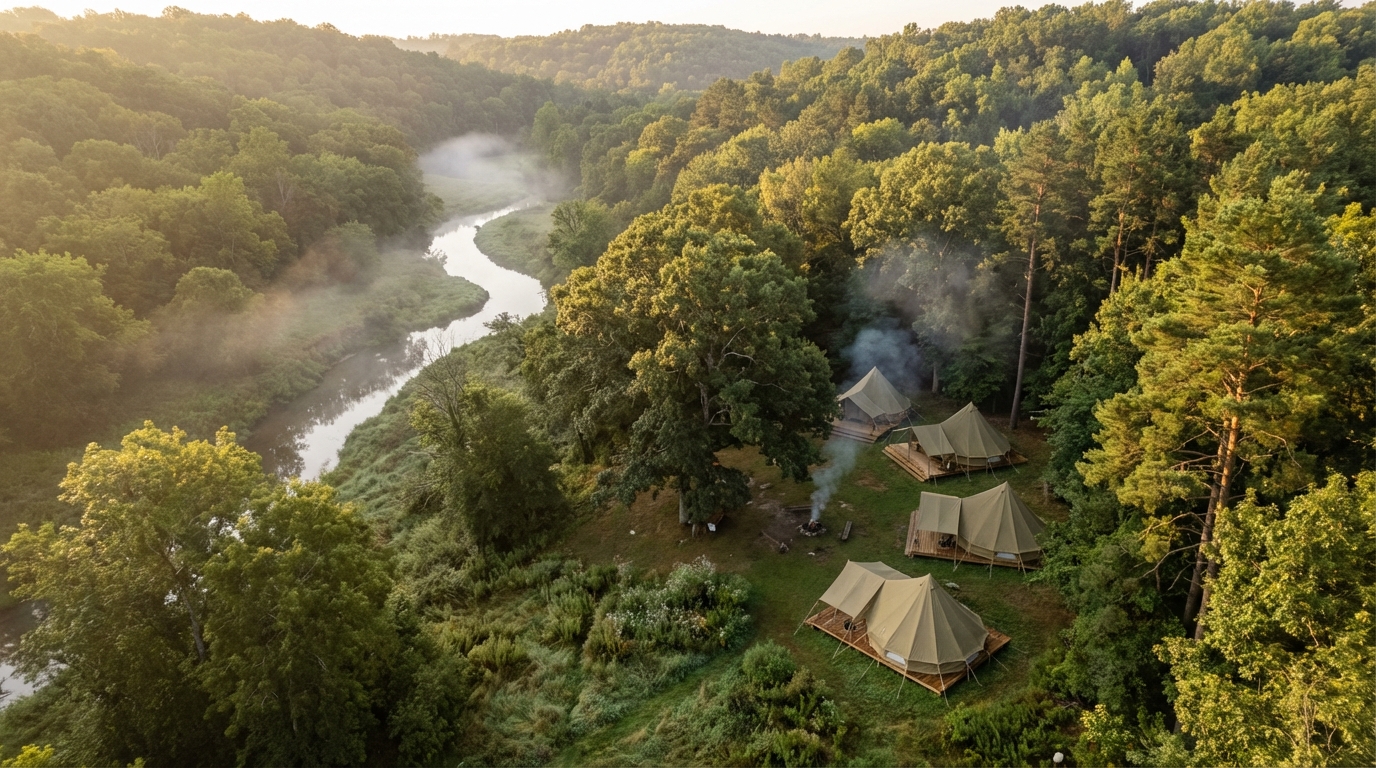

Georgia lawmakers are considering legislation that would expand the state’s primary financial incentive for private land conservation, a move that could significantly benefit campground owners, RV park operators, and glamping resort developers seeking to protect the natural landscapes that draw guests to their properties.
House Bill 1148, sponsored by Representative Chas Cannon (R-172), proposes extending the Georgia Conservation Tax Credit program through 2031, while increasing the annual tax credit cap from $4 million to $30 million, according to the Georgia Conservancy’s report.
For outdoor hospitality operators with qualifying properties, the proposed expansion represents a substantially larger pool of incentives for land conservation efforts that can simultaneously protect business assets and generate meaningful tax benefits.
Protecting natural landscapes can be both environmentally responsible and strategically beneficial for outdoor hospitality business models. Natural settings often serve as a primary draw for campground and glamping resort guests.
Many outdoor hospitality properties sit on land that qualifies for conservation consideration, including parcels adjacent to state parks, properties containing significant wildlife habitat, and land featuring mature forests or waterfront access.
The Georgia Conservation Tax Credit program has already demonstrated substantial success in protecting the state’s natural resources.
Since 2014, the program has supported $119 million in conservation value and conserved more than 255,000 acres across Georgia.
The program has been utilized in 130 counties throughout the state, reflecting broad geographic participation. With the vast majority of Georgia’s acres under private ownership, private land conservation through programs like the GCTC plays an especially important role in maintaining the state’s environmental integrity.
Under current program rules, the GCTC provides a tax credit of up to 25% of fair market value for qualifying conservation donations. Individual property owners can receive up to $250,000 in credits, while partnerships and corporations face a cap of $500,000.
Operators considering conservation easements should work with qualified land trusts and legal counsel who understand both conservation requirements and commercial hospitality operations.
The five-year extension to 2031 provides a longer planning horizon for operators considering land protection as part of their long-term business strategy. Properties combining conservation commitments with visible sustainability features may differentiate themselves in an increasingly competitive market.
Outdoor hospitality businesses that demonstrate environmental stewardship through conservation easements can amplify their sustainability credentials by implementing complementary improvements.
Low-impact site design options include permeable surfaces for roads and parking areas, native plant landscaping that minimizes irrigation needs and supports local ecosystems, and designated buffer zones between campsites and sensitive natural areas.
Interpretive signage explaining conservation features can add educational value to the guest experience while trail maps highlighting protected natural areas encourage responsible recreation.
