

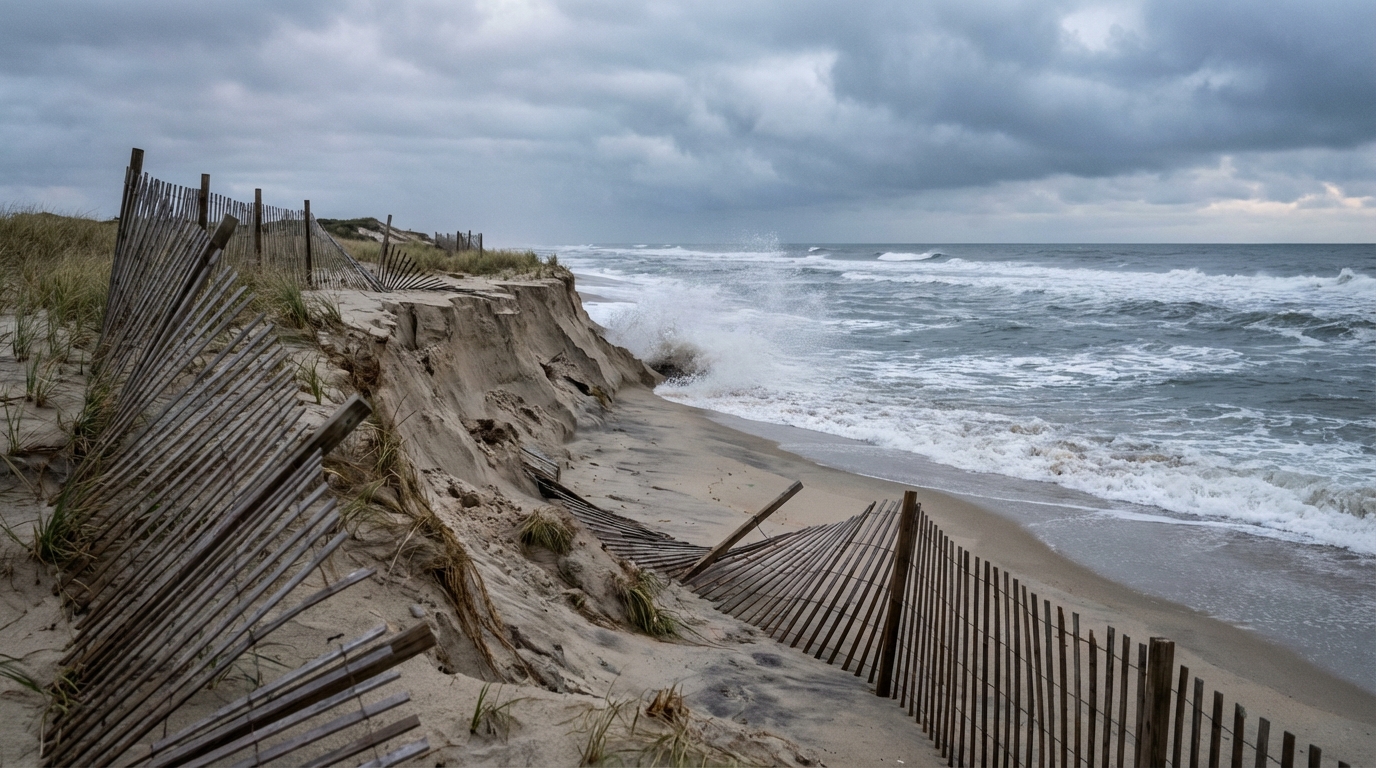

Severe coastal erosion along the Jersey Shore threatens to derail the 2026 summer tourism season, with local leaders in Ocean City and Strathmere issuing urgent warnings that federal aid must arrive before Memorial Day or communities will face devastating economic and safety consequences. North-end beaches in Ocean City have become critically short at high tide following a punishing series of recent storms, leaving stretches of coastline that typically draw millions of visitors in a precarious state. The stakes extend far beyond sand and surf, as New Jersey’s tourism industry generated a record $50.6 billion in 2024, making the race to restore these beaches a matter of economic survival for communities that depend on summer visitors.
The scale of damage has moved well beyond what local stopgap measures can address. James W. Van Zlike, township administrator for Upper Township, offered a sobering assessment of conditions in Strathmere. “In terms of short-term measures ahead of the 2026 summer season, there are no meaningful interim actions that would materially restore the beach,” Van Zlike said. “In Strathmere, the erosion is substantial enough that only a full-scale nourishment project would make a noticeable difference. Smaller efforts would not significantly change current conditions.” For decades, the U.S. Army Corps of Engineers has overseen beach replenishment projects along the Jersey Shore authorized by Congress, pumping sand onto eroded beaches and reinforcing dunes as part of comprehensive coastal protection plans, according to WHYY reporting. These projects serve dual purposes, supporting tourism-dependent local economies while shielding homes, roads, and critical infrastructure from coastal flooding.
The uncertainty surrounding federal funding timelines creates immediate challenges for businesses that depend on healthy beaches. For campground, RV park, and glamping resort operators in coastal regions, the erosion crisis presents immediate operational challenges that extend beyond waiting for federal action. Properties that market beach access as a primary amenity now face difficult conversations with guests who have already booked summer stays. Operators in Ocean City, Strathmere, Brigantine, and North Wildwood areas must navigate guest expectations while federal funding timelines remain frustratingly uncertain. Industry experience consistently demonstrates that proactive outreach to guests with existing reservations performs better than reactive messaging after problems escalate. Sending updates about local conditions, even when the news is mixed, helps build trust and reduces the surge of last-minute cancellations that can devastate seasonal revenue projections.
The current funding impasse traces directly to Washington. Federal replenishment funding was largely absent from the fiscal year 2025 budget, leaving shore towns dependent on emergency allocations that remain unfinalized as summer approaches. While U.S. Representative Jeff Van Drew and Army Corps of Engineers officials toured damaged sites in February and promised relief, the timeline for actual project completion remains uncertain as of early March. Dan Ginolfi, executive director of the American Coastal Coalition, explained the structural problem underlying these delays. “These projects are authorized by Congress for 50-year federal participation,” Ginolfi said. “The problem is that each nourishment episode is subject to appropriations by Congress.” Federal officials and coastal advocates confirm that inconsistent appropriations have delayed projects nationwide, with the Jersey Shore among the hardest-hit regions.
The consequences of inaction would ripple through every sector of the coastal economy. Van Zlike outlined what communities face if replenishment fails to materialize before summer. “If no project occurs before summer 2026, impacts would include reduced beach width, diminished recreational space and continued exposure of public infrastructure and private property to storm risk,” he said. “Doing nothing long-term is not a viable option, but timing is directly tied to the availability of federal funding.” While Upper Township has secured its share of available state funding, Van Zlike noted the fundamental obstacle: “The primary uncertainty continues to be the federal portion, which traditionally represents the majority of project funding.”
With federal funding timelines uncertain, outdoor hospitality operators can take proactive steps to protect their businesses. Outdoor hospitality operators facing this uncertainty can implement strategies to protect both revenue and guest relationships. Properties in environmentally vulnerable areas often adopt tiered cancellation policies that balance guest flexibility with business protection, and offering rebooking incentives rather than full refunds tends to retain revenue while preserving customer goodwill. Modern reservation management systems allow operators to segment communications based on booking dates, enabling targeted messaging to guests arriving during potentially affected periods. Successful coastal campgrounds typically develop contingency marketing that emphasizes non-beach amenities when shoreline conditions are compromised. Pools, fishing piers, kayak launches, nature trails, and indoor recreation facilities can be highlighted to maintain perceived value even when primary beach access is limited.
Communities have not waited idly for federal salvation. Late last year, Ocean City and Strathmere declared states of emergency, with Ocean City publicly announcing it was stockpiling sand to protect its beaches. Brigantine and North Wildwood joined the list of communities declaring local emergencies earlier in the year. Avalon borough, as of early February, deployed two newly acquired sand-moving trucks to combat severe northern beachfront erosion caused by Hurricane Erin and subsequent 2025 storms. With federal funding for traditional hydraulic beach fill unavailable for the 2026 cycle, Avalon is seeking bids for a sand operation to restore dunes and shorelines this spring through its own resources.
Legislative solutions are gaining momentum on Capitol Hill. Van Drew and Rep. Laura Gillen, D-N.Y., have introduced bipartisan legislation that would create a permanent funding stream for coastal storm protection projects, including beach nourishment. The proposed Coastal Trust Fund would establish a dedicated revenue source funded by offshore energy lease revenues and invest $1 billion annually into coastal storm risk management projects led by the Army Corps. “The American coastal economy contributes to 46 percent of national GDP, but too often the government does not deliver coastal protection until after a disaster strikes,” Van Drew stated. Ginolfi endorsed the legislative approach enthusiastically. “This bill establishes a reliable and dedicated revenue stream in an amount that would satisfy the needs of coastal communities nationwide,” he said.
Despite funding challenges, the Army Corps is moving forward where possible. Van Drew has identified Ocean City as a top priority for federal investment, directing tens of millions of dollars toward beach replenishment there. “We are working to secure federal funding for as many shore communities as possible, and Ocean City is simply the starting point because it was next on the U.S. Army Corps of Engineers’ existing construction schedule,” Van Drew explained. “This is not a one-town solution. More communities are expected to move forward as funding is finalized, and the Army Corps has indicated they will be expediting the process so that as much work as possible can be completed ahead of the summer season.” Beach replenishment projects typically involve partnerships among federal, state, and local governments, with the Army Corps overseeing engineering and construction while the New Jersey Department of Environmental Protection administers the Shore Protection Fund, providing approximately $25 million annually. Separately, FEMA will distribute funds for the long-awaited $24.3 million seawall expansion project in Cape May, though construction is not expected to begin until fall 2026.
The debate over protection methods adds another layer of complexity. Van Zlike acknowledged the ongoing disagreement among engineers and coastal specialists. “Some engineers advocate for hard structures such as seawalls or other armoring approaches, while others caution that these can worsen erosion in adjacent areas,” he said. “These structures are also extremely expensive and are not guaranteed to stop regional erosion trends. Neighboring municipalities with hardened infrastructure continue to experience erosion challenges, which highlights the complexity of the issue.”
For outdoor hospitality operators in vulnerable coastal zones, the current crisis underscores the importance of building environmental resilience into long-term capital planning rather than treating it as emergency response. Properties in erosion-prone areas benefit from periodic professional assessments of how site layouts may need to evolve, with options including relocating premium waterfront sites slightly inland, improving drainage systems, and creating natural buffer zones. Living shoreline techniques using native vegetation and natural dune systems have gained acceptance as cost-effective alternatives to hardscape solutions, often qualifying for environmental grants while appealing to eco-conscious camping guests. Investment in splash pads, resort-style pools, covered pavilions, and indoor recreation spaces provides weather-independent guest value that reduces reliance on public beach access. Private outdoor hospitality businesses also benefit from participating in municipal and regional coastal protection coalitions, as joining tourism board discussions about federal funding priorities can help ensure private recreational lands are considered in regional protection plans.
The path forward remains uncertain, but Ginolfi urged stakeholders to make their voices heard. “Funding right now is far below usual levels, and the best way to support funding for beaches is by contacting legislators and letting them know that the nation’s beaches are in dire need of attention,” he said. Operators are advised to review insurance coverage annually as erosion patterns shift and maintain emergency reserve funds specifically for storm recovery, with particular attention to understanding the distinction between flood insurance and erosion coverage to prevent gaps in protection. The Jersey Shore erosion crisis illustrates broader vulnerabilities facing coastal outdoor hospitality properties nationwide, and properties that implement robust communication strategies and infrastructure planning now can preserve bookings and reputation regardless of whether sand replenishment occurs before Memorial Day. The race against the clock continues as federal funding timelines and bureaucratic processes move at their own pace while businesses and communities prepare for whatever summer brings.
