

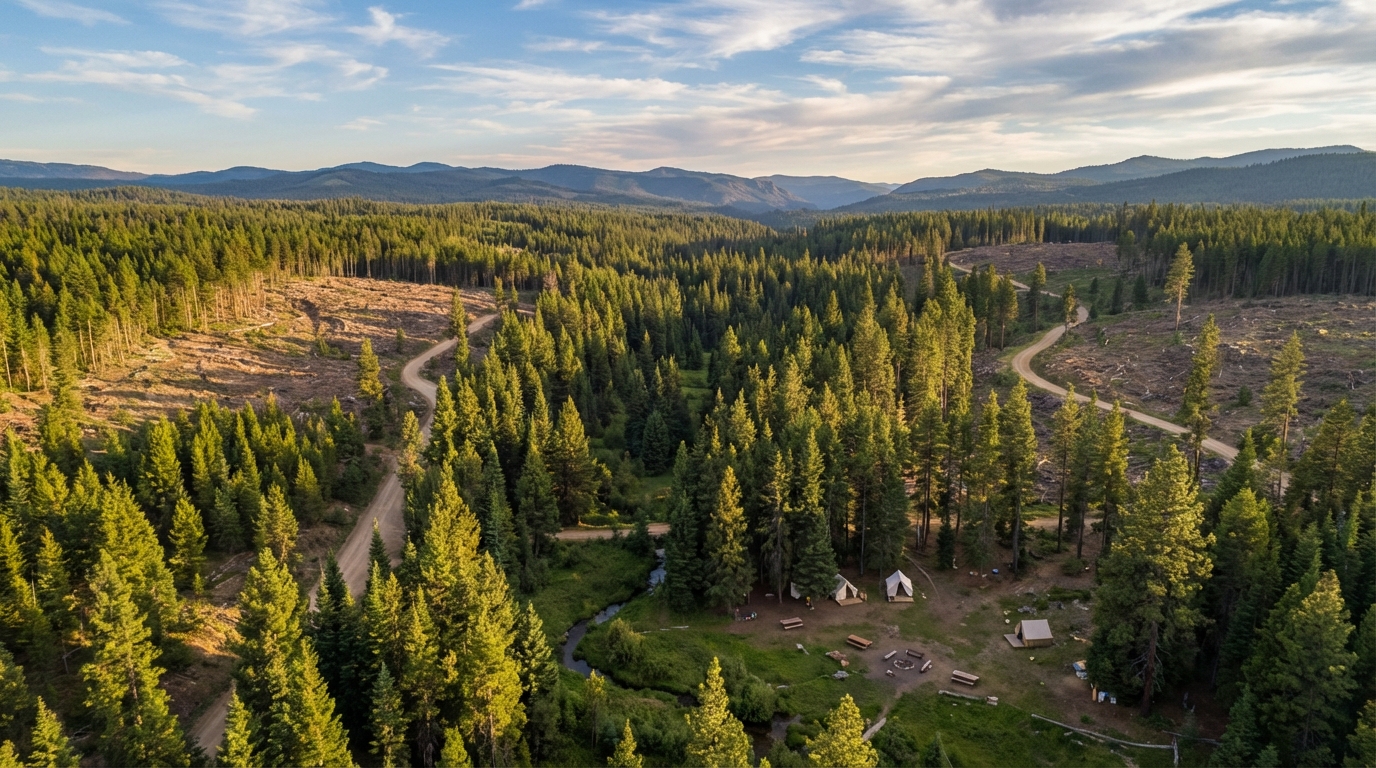

Utah and the U.S. Forest Service have finalized a sweeping 20-year agreement that grants the state significantly expanded authority over approximately 8.2 million acres of national forest land, a development that carries substantial implications for outdoor hospitality operators whose businesses depend on recreation access and infrastructure within these public lands.
Governor Spencer Cox and U.S. Forest Service Chief Tom Schultz signed the compact on Jan. 8, 2026, establishing what officials describe as a “shared stewardship” initiative aimed at increasing timber harvesting, accelerating landscape-scale restoration and reducing wildfire threats through tree cutting. The agreement represents a notable shift in federal-state land management dynamics across the American West, with recreation infrastructure explicitly included among the areas where Utah will now exercise greater decision-making power.
Under the terms of the new compact, Utah gains a more prominent voice in decisions concerning new legal authorities, management tools, financial resource sharing and resource leveraging for priority work. The state’s expanded influence extends across logging, grazing, mining coordination, recreation infrastructure, wildlife management and water management, as Western Priorities reported.
State and county governments will also gain increased say in planning and implementing watershed restoration, grazing projects and recreation projects including trails and campgrounds. While a previous Shared Stewardship Partnership between Utah and the Forest Service has existed since 2019, this new agreement substantially expands state decision-making power and cements Utah’s influence over federal forest management decisions.
Given these expanded state powers over recreation infrastructure, campground operators and outdoor hospitality businesses throughout Utah should prepare for direct impacts on their operations. When state governments gain expanded authority over federal forest lands, outdoor hospitality operators often experience shifts in permitting processes, access road maintenance priorities and recreation development timelines.
Operators with businesses adjacent to or within national forest boundaries should maintain open communication channels with both state and federal land management offices to stay ahead of policy changes affecting access routes or guest experiences. Building relationships with local ranger districts and state forestry officials creates opportunities to participate in public comment periods and stakeholder meetings, while diversifying trail access points and recreation partnerships reduces business vulnerability during management transitions or temporary closures.
Monitoring state recreation development priorities can reveal opportunities for public-private partnerships in campground development or trail system expansion. Operators who proactively engage with land management planning processes often secure more favorable outcomes for access and infrastructure improvements.
Digital guest engagement platforms now allow campground operators to provide real-time updates about trail conditions, access changes and fire restrictions, tools that have become increasingly valuable as land management policies evolve.
Utah joins a growing roster of Western states formalizing similar arrangements with the Forest Service. Idaho signed a comparable compact in December, while Montana formalized its agreement in October, reflecting a broader trend in federal-state land management relationships. These agreements align with a directive from former President Donald Trump in March that instructed federal agencies to expedite approval of logging projects and establish timber sale goals as a means of mitigating wildfire risks.
Campground and RV park operators in Idaho and Montana should monitor implementation of similar agreements in those states for parallel impacts on recreation access and development priorities.
The Center for Biological Diversity and other environmental organizations have responded to the Utah agreement with criticism, warning that expanded state control threatens federal protections and public participation in land management decisions.
“This agreement strips federal protections, shuts the public out of decision-making, and puts Utah’s old-growth forests directly on the chopping block,” said Laiken Jordahl, national public lands advocate at the Center for Biological Diversity. Environmental advocates argue the deal represents a dangerous move toward increased state control and potential privatization of public lands while limiting public oversight and weakening environmental reviews.
Steve Bloch, legal director at the Southern Utah Wilderness Alliance, expressed concern about stakeholder participation under the new framework.
The agreement “sets the stage for Utah officials to have both a heavy hand and the loudest voice” in the room, “crowding out all other stakeholders,” Bloch said regarding the expanded state and county involvement in planning watershed restoration, grazing and recreation projects. Critics contend that the focus on timber removal overstates its benefits in wildfire reduction, arguing that weather, high winds, drought and climate change serve as primary wildfire drivers. They suggest habitat restoration through smaller-scale operations could prove more appropriate than aggressive logging approaches.
Mike Garrity, executive director of the Alliance for the Wild Rockies, offered particularly pointed criticism in comments to the Salt Lake Tribune. “The Shared Stewardship Agreement is nothing more than a sneaky way to clearcut roadless areas in national forests in Utah,” Garrity stated. “Roadless areas provide clean drinking water and function as biological strongholds for populations of threatened and endangered species.”
While state officials and conservation groups debate the effectiveness of increased timber harvesting for wildfire reduction, outdoor hospitality operators near these lands should maintain robust preparedness protocols regardless of adjacent management approaches.
Creating and maintaining defensible space around all structures, typically involving vegetation management within 100 feet of buildings, represents a foundational practice. Installing clear safety signage marking evacuation routes and emergency assembly points throughout properties, training staff annually on emergency evacuation procedures and guest communication protocols, and establishing relationships with local fire departments for early warnings all contribute to comprehensive preparedness.
Documenting fire mitigation efforts thoroughly can yield favorable insurance terms, while investing in air quality monitoring tools to inform guests about smoke conditions has become an expected amenity in fire-prone regions.
Infrastructure investments that serve both fire safety and sustainability purposes have gained traction in the outdoor hospitality industry. Fire-resistant building materials, metal roofing, ember-resistant vents and strategic landscaping with fire-resistant native plants represent investments serving dual objectives. Properties that position these upgrades as part of their environmental commitment often find guests respond positively to the messaging.
Proactive communication about fire conditions and forest management activities builds guest confidence, and many successful operators now include information about nearby forest health initiatives in pre-arrival communications, framing active management as a positive indicator of reduced long-term fire risk.
Utah officials have defended the agreement as essential for the state to secure “a seat at the table” in managing national forest lands, asserting that Utah possesses the expertise to manage these lands effectively. State officials characterize the deal as improving efficiency and collaboration between government entities. The agreement emphasizes engaging with tribes, local governments and industry to build support and capacity for priority initiatives, with plans for coordinating cross-boundary priorities as detailed in coverage from Western Priorities.
The 20-year duration of the agreement signals a long-term policy direction that outdoor hospitality operators should factor into strategic planning.
Campground operators near national forest boundaries may find new opportunities for state agency partnerships on trail connectivity, though they may also need to adjust marketing strategies if access patterns change over time. The agreement could mean increased activity from logging operations in the near term but potentially reduced wildfire intensity over the longer horizon.
Operators seeking additional details about the agreement’s implementation can find further coverage from the Salt Lake Tribune and Utah News Dispatch.
For the outdoor hospitality industry, the compact represents a significant development worth monitoring closely, carrying both potential opportunities in accelerated recreation infrastructure development and important considerations around changing access dynamics across 8.2 million acres of Utah’s national forest lands.