

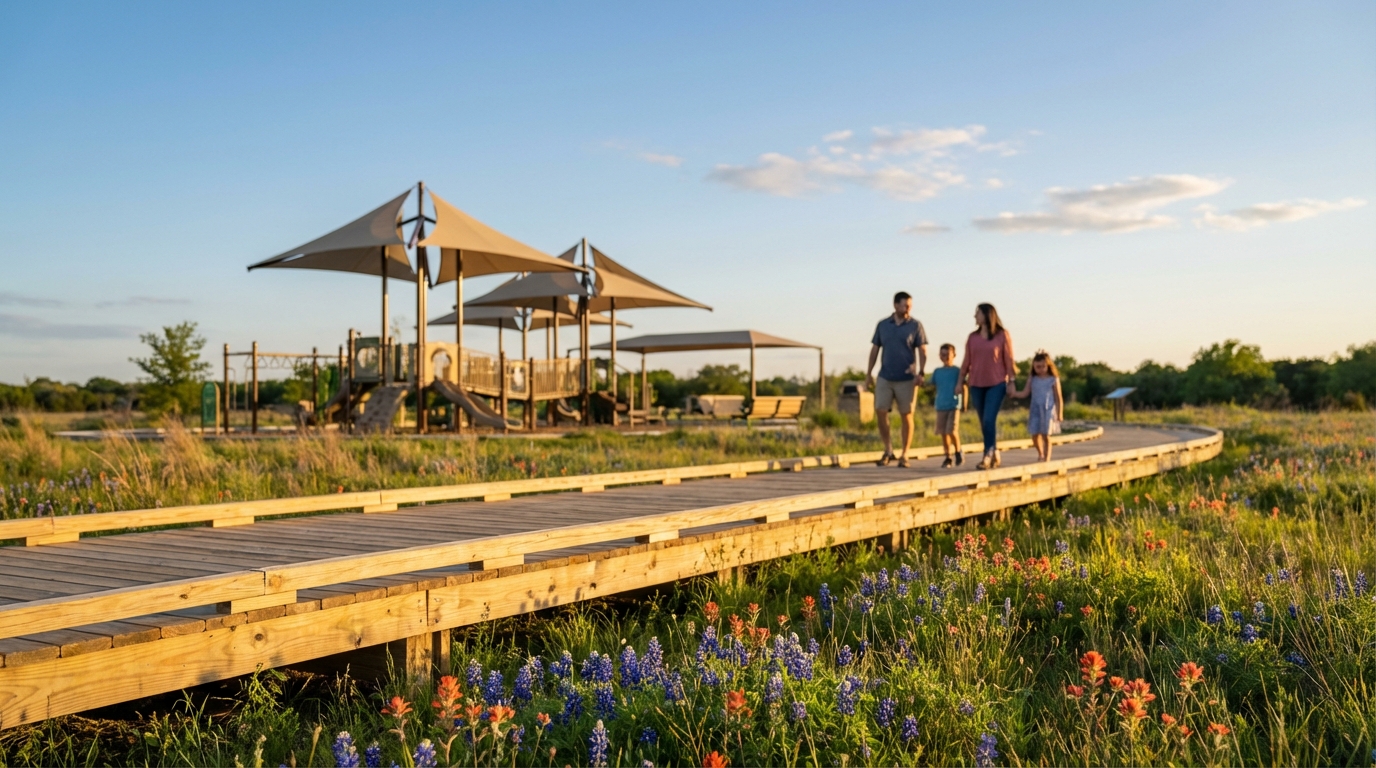

The Texas Parks and Wildlife Commission has approved more than $21.2 million in competitive local park grants, establishing a new record for the program and directing funds toward 50 community parks across the state. The grants were approved during the commission meeting held Jan. 22, 2026, with the announcement made on Jan. 29, 2026, signaling significant public investment in outdoor recreation infrastructure that private campground and RV park operators may find strategically valuable when evaluating location-based business decisions. From nature trails and kayak launches to playgrounds and sports fields, the funded amenities represent the types of outdoor attractions that consistently drive guest destination selection for nearby outdoor hospitality businesses.
The grants operate on a 50-50 reimbursement match basis to local government entities, meaning recipient communities must contribute matching funds for their approved projects. Once funded, sites must remain parkland in perpetuity, properly maintained and open to the public. This permanence requirement provides long-term certainty for private outdoor hospitality businesses considering proximity to these enhanced public amenities as part of their operational planning. When local communities invest in quality trails, water access points and nature areas, campgrounds and RV parks in surrounding regions often experience measurable benefits from increased visitor traffic to the area.
The commission distributed awards across three distinct categories based on population thresholds. Urban Outdoor Recreation Grants, reserved for local governments serving populations exceeding 500,000, went to two communities. Non-Urban Outdoor Recreation Grants supporting municipalities under 500,000 were approved for 26 communities. Small Community Recreation Grants serving towns with fewer than 20,000 residents were awarded to 14 communities. Funding sources include the federal Land and Water Conservation Fund, the Urban Parks Account and the Texas Recreation and Parks Account, which receives support from sporting goods sales tax revenue and federal offshore oil and gas royalties.
Among the largest awards, the City of San Antonio received $1.5 million for improvements to Pearsall Park, including a bike track, lighting, shade structures and track perimeter construction. The City of Fort Worth secured $1.5 million for phase two improvements to Oak Grove Park, encompassing a loop trail, nature area, practice fields, pavilion, sports courts, playground and parking area. The City of Kyle was awarded $750,000 for phase one renovations at Steeplechase Park, with project elements including a 12-foot multi-modal trail with lighting, disc golf, sports courts, a pedestrian bridge, interpretive and wayfinding signage, native landscaping and creek restoration. New Braunfels received $700,890 for a neighborhood park on Coll Street featuring a pavilion, accessible playground, rain garden, native landscaping and irrigation systems.
For private outdoor hospitality operators, these major regional investments create multiple opportunities for strategic alignment. Marketing integration represents one straightforward approach—promoting nearby public amenities in campground marketing materials helps guests understand the full recreational value of an area. Operators may consider featuring trail maps and local attraction guides as standard guest resources. When public parks add water access points, nearby private operators often find success developing complementary services such as watercraft rentals, guided tours or shuttle services to trailheads.
Water-focused and nature-oriented projects received substantial funding throughout the grant cycle. The City of San Benito was awarded $750,000 for its Wetlands park project, which will include a restroom, interpretive kiosk, rainwater catchment system, pollinator gardens, trails with culverts for gravity-driven water flow, native habitat enhancement, bird blinds, environmentally sensitive lights, permeable parking and a bike repair station. Cameron County received $750,000 for phase two improvements at Bejarano-McFarland Park, featuring a permeable trail network, a boardwalk over the Laguna Madre and a kayak launch with wade fishing access. The City of Wimberley secured $750,000 for improvements at Blue Hole Regional Park, including a playground, amphitheater and gathering space, native landscaping, trails and rainwater catchment. Live Oak County received $150,000 for Longhorn Park improvements including a concrete fishing pad on the riverbank, bat houses and a bird blind as part of the commission’s grant allocations.
Establishing relationships with local parks departments can create valuable opportunities for joint programming, referral arrangements and inclusion in regional tourism initiatives. Private campgrounds located near newly improved public parks may benefit from investing in connector trails, bike-friendly infrastructure or wayfinding signage that helps guests easily access public amenities. These collaborative approaches strengthen the overall appeal of a destination while distributing the infrastructure investment burden between public and private entities.
Inclusive design emerged as a consistent priority across numerous grant awards. The City of Castroville received $469,367 for improvements at Lion’s Parks, including an inclusive playground, triple-bay swing shade, sensory wave seat and walkway. The City of Edinburg was approved for $347,927 to fund Memorial Park improvements featuring two versatile tennis courts with pickleball functionality, an inclusive Bankshot-style basketball play court with shade structures, Americans with Disabilities Act-compliant sidewalks, benches, native landscaping and solar lighting. The City of Henrietta secured $150,000 for playground equipment with inclusive elements and surfacing, an outdoor music ensemble and a concrete ADA-compliant ramp. Multiple projects throughout the grant list specifically mention ADA accessibility improvements as core components.
The emphasis on inclusive amenities reflects a broader industry shift toward universal design principles in outdoor recreation that private operators should recognize. For campground owners, glamping resort managers and RV park operators, implementing accessible features has become both an ethical imperative and a sound business practice. Common approaches include ADA-compliant site design with firm, level surfaces and paved pathways connecting accessible sites to bathhouses and common areas. Inclusive playground features incorporating ground-level play elements, wheelchair-accessible swings and sensory play stations welcome children of all abilities. Universal waterfront access through kayak launch systems with transfer platforms and accessible fishing piers expands the potential guest base significantly. Sensory-friendly considerations such as quiet hours policies, designated low-stimulation areas and clear visual signage support guests with autism spectrum disorders and sensory processing differences.
Sports and recreation complex improvements received attention across community sizes. The City of Glen Rose was awarded $750,000 for renovation of Glen Rose Soccer Park, including walking trail reconstruction with solar lighting, playground rehabilitation with shade, soccer field rehabilitation, a pickleball court with solar lighting and irrigation system upgrades. The City of Gatesville secured $150,000 for phase two improvements to the Gatesville Sports Complex, specifically for sports lighting installation. The City of The Colony received $750,000 for development at the B.B. Owens Softball Complex, encompassing sport fields, playground, trails and native landscaping. The City of Wellington was approved for $750,000 for renovations at Ellison Park, including a playground with inclusive elements, resurfaced tennis courts, pickleball courts, sand volleyball, t-ball fields, a xeriscape garden and a smart irrigation system.
Small communities across Texas benefited substantially from the grant program. The City of Childress received $150,000 for Fair Park improvements including a recirculating splashpad, concrete pathways and shaded seating. The City of Spearman secured $150,000 for an inclusive splashpad at Martin Park. The City of Turkey was awarded $150,000 for pedestrian trails, a basketball court, restroom and playground equipment. The City of South Padre Island received $150,000 for Water Tower Park revitalization including new turf, playground replacement and basketball court resurfacing. For operators in smaller markets, establishing relationships with local parks departments in these communities can create valuable referral arrangements and strengthen regional tourism appeal.
The grant recommendations were formally presented and approved during the Texas Parks and Wildlife Commission meeting held Jan. 22, 2026, at TPWD Austin Headquarters. The commission reviewed applications from eligible entities requesting more than $47 million in matching fund assistance, with the approved $21.2 million representing staff recommendations to support the highest-scoring projects based on program criteria. Provisions exist to grant additional support if more funds become available within the current fiscal year. Private outdoor hospitality operators throughout Texas should monitor these 50 park development projects as potential catalysts for regional tourism growth, recognizing that technology solutions such as virtual tours showcasing accessibility features and online booking systems with detailed site accessibility filters have become expected tools for attracting guests seeking specific accommodations. The record-breaking funding cycle underscores the state’s commitment to outdoor recreation infrastructure that benefits both public visitors and the private businesses that serve them.
