
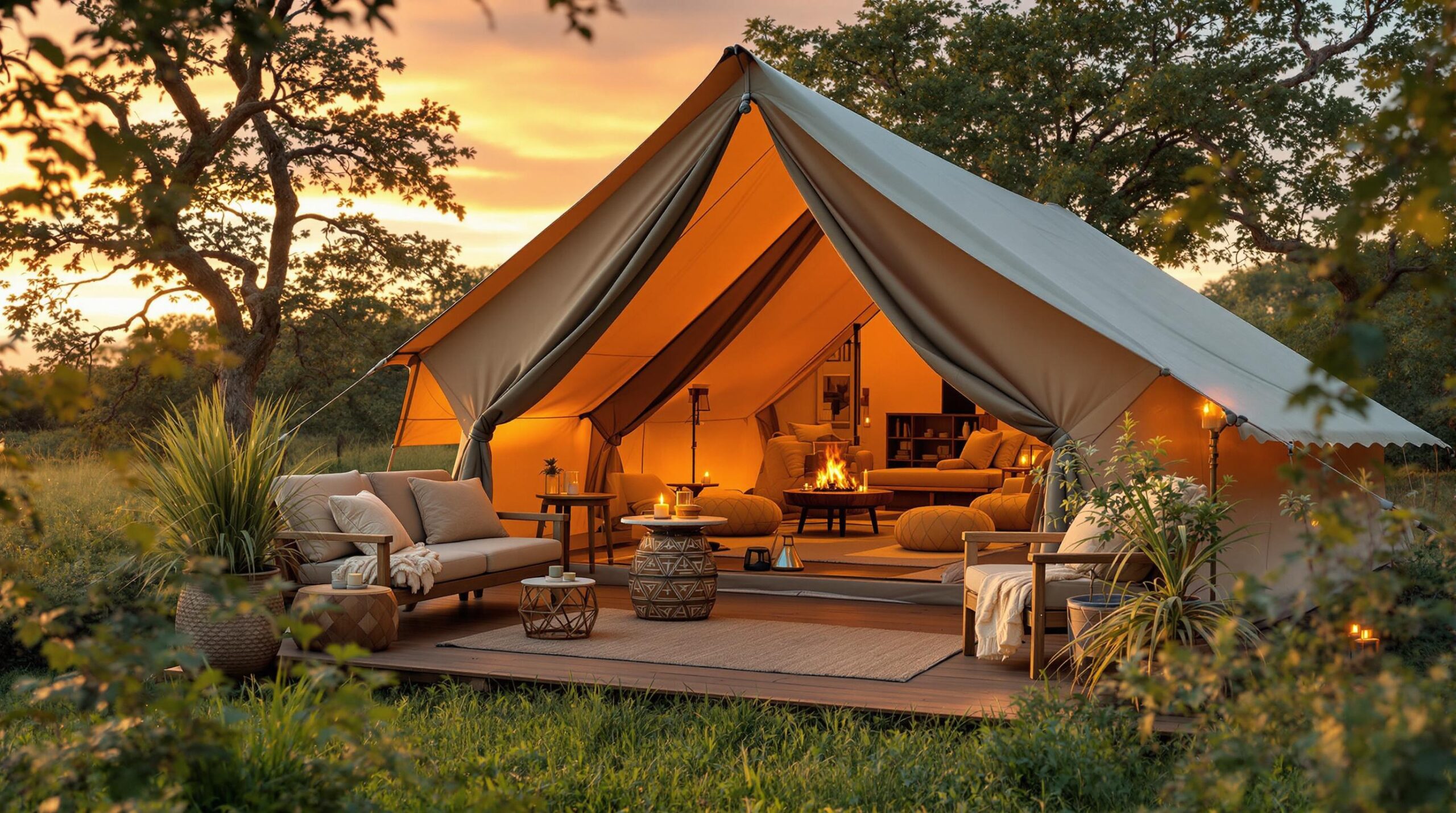

Resort developers planning tented accommodation projects in 2026 are weighing supplier capabilities, structural specifications, customization options, and regulatory requirements as demand for safari-style lodging continues to shape the outdoor hospitality market.
The global safari tourism market is projected to grow from $39.7 billion in 2026 to $66.9 billion by 2033, according to Grand View Research. The projected growth points to continued investment opportunities for resort developers, including those considering permanent or semi-permanent tented accommodations as alternatives to conventional hotel construction.
However, selecting a safari tent manufacturer involves more than comparing designs and quoted prices. Developers must assess whether proposed structures meet local building and fire safety requirements, withstand site-specific weather conditions, and support the operational needs of the intended accommodation model.
A recent industry overview identified nine manufacturers and suppliers offering safari tents, modular lodge structures, and other glamping accommodations. According to a press release, the companies were assessed using five criteria: conformity documentation, manufacturing capabilities, transparency of material and structural specifications, experience with resort projects, and customization options.
The companies included in the overview are Stars Glamping, Bushtec Safari, YALA Luxury Canvas Lodges, Exclusive Tents International, Tenthouse Structures, Freeform, Guangzhou Jumei Tent Technology Co., Ltd., Yards Home Technology Co., Ltd., and TENTSXPERT. The editorial assessment placed these companies in a ranked order, although no trade association, certification body, or government agency issued or endorsed the ranking.
Stars Glamping, based in Guangzhou, China, was placed first. Operating as Stars Glamping TENT CO., LTD, the manufacturer has a reported 20,000-square-meter production facility in Nansha District, Guangzhou, alongside a 4,000-square-meter exhibition hall and an in-house research team of six engineers.
Its safari tent range includes the Lodestar, Vega, and Epic models. The company specifies 850-gram-per-square-meter PVC-coated polyester covers, a minimum hydrostatic head of 3,000 millimeters, and a B1 fire-retardant classification. The tents are also advertised with wind resistance of up to 100 kilometers per hour and a service temperature range of minus 25 to 60 degrees Celsius. Standard footprints range from 20 to 50 square meters.
The manufacturer also lists an EU General Product Safety Directive attestation of conformity, certificate M.2024.206.C96444, issued by UDEM against EN ISO 5912:2020. The certificate identifies the Safari Tent – Epic and Safari Lodge among the covered products and is valid until January 30, 2029. Customization options include fabric and frame materials, interior layouts, bathroom integration, and branding. The company reports exporting to more than 40 countries.
South Africa-based Bushtec Safari ranked second. The company reports more than 55 years of trading and offers luxury safari tents and complete lodge installations. It also states that it holds ISO 9001 and ISO 14001 certifications and has delivered more than 1,000 projects across over 80 countries.
Its experience with remote and off-grid developments is particularly relevant to resort operators planning accommodations in locations with limited infrastructure. Projects requiring independent power and water systems involve additional considerations, including equipment placement, installation logistics, and access to maintenance services. Developers should confirm that references and technical documentation reflect conditions comparable to their intended sites.
YALA Luxury Canvas Lodges, headquartered in the Netherlands, ranked third. The company combines in-house design and production with interior fit-out and modular lodge solutions. Its stated sales network covers at least 40 countries, while its product offering includes luxury safari lodges and canvas structures.
For European resort developments, integrating tent manufacturing and interior delivery through one supplier may reduce coordination between contractors responsible for the structure, joinery, and furnishings. However, developers pursuing sustainability targets should request supporting documentation for materials and manufacturing practices rather than relying solely on general environmental positioning.
Exclusive Tents International, another South African manufacturer, ranked fourth. The family-run company specializes in handcrafted luxury safari and glamping tents, with bespoke designs and material selection among its stated capabilities. Its approach may suit operators developing smaller, design-led properties where customized construction is part of the accommodation’s positioning.
The trade-off for bespoke manufacturing is the need to establish production schedules, replacement component availability, and documentation for individual units. These considerations can affect the long-term operating costs of a resort, particularly when replacement covers or structural components must be transported internationally.
Tenthouse Structures ranked fifth, offering lodge tent architecture and modular tent systems. Its team includes architecture and textile engineering specialists, supporting projects where structural design, membrane tensioning, roof geometry, and connection details require project-specific consideration. The company also offers services extending from design to installation, which may be relevant to wilderness developments with limited access to local contractors.
Freeform, ranked sixth, specializes in fabric architecture, including stretch tents, glamping ecopods, and safari-adapted structures. Its tensioned fabric designs provide an alternative to conventional framed safari tents, particularly for operators seeking distinctive architectural concepts. However, developers should request specific evidence supporting safety and compliance claims and verify that anchoring systems are suitable for the site’s soil and ground conditions.
China-based Guangzhou Jumei Tent Technology Co., Ltd., operating as Jumei Glamping, ranked seventh. Its product range includes safari tents, glamping domes, stretch tents, and prefabricated tent structures. The company’s broad offering may appeal to developers planning properties with multiple accommodation categories who want to consolidate procurement and shipping through one supplier.
Yards Home Technology Co., Ltd., operating as YARDS Home, ranked eighth. The manufacturer supplies safari tents, glamping pods, safari lodges, and dome tents, and reports holding ISO 9001 certification. For resort operators, the certification provides information about the supplier’s quality management system but does not independently establish the performance of every product. Product-specific testing remains necessary when assessing fire resistance, structural capacity, and weather protection.
TENTSXPERT, also based in China, ranked ninth. The manufacturer offers luxury glamping and safari tents, with customization, four-season configurations, international delivery, and site installation among its stated services. Its own-factory production model may be relevant to developers seeking a supplier that can manage manufacturing and installation. Buyers considering winter operations should request details of insulation configurations, condensation control, and the temperature ranges supported by the proposed structure.
Beyond supplier selection, the specifications of the accommodation itself can significantly influence project costs and operating requirements.
Commercial indications for standard safari tent packages designed for two to four occupants have ranged from approximately $8,190 to $15,710, depending on the included components. These figures should be treated as indicative rather than directly comparable quotations, as differences in foundations, decking, insulation, interior fit-out, transportation, and installation can substantially affect the final cost.
Import duties are another consideration for developers sourcing structures internationally. In the United States, the Harmonized Tariff Schedule classifies certain synthetic-fiber tents, excluding backpacking models, under HTS 6306.22.90.30, with a general duty rate of 8.8%. Actual import treatment should be confirmed against the applicable product classification and current customs requirements. Developers should also account for freight, customs-related charges, site preparation, and installation labor when calculating landed costs.
Technical specifications are particularly important because safari tents intended for resort use function as semi-permanent accommodation structures rather than conventional recreational camping equipment. A waterproofing claim, for example, should be supported by a published hydrostatic head rating and cover weight. Fire-retardant claims should identify the applicable testing standard and classification, while structural documentation should specify wind resistance and snow-load capacity relevant to the development site.
Frame construction also affects durability and maintenance. Developers comparing steel-frame and timber-frame systems should examine corrosion protection, material treatment, connection methods, and the availability of replacement components. For modular systems, the design of joints and anchoring points is equally important, particularly when a resort plans to expand its accommodation inventory in phases.
Interior requirements can further influence the structural and service specifications. Tents incorporating private bathrooms, kitchens, electrical systems, and additional insulation require more extensive planning than basic sleeping accommodations. Operators developing off-grid properties must also consider water storage, wastewater treatment, energy generation, and maintenance access.
The assessment’s findings are limited by the information publicly disclosed by manufacturers. Some performance figures and capability statements are company-provided claims rather than independently verified test results. Certification documents, fire classifications, structural calculations, and electrical specifications should therefore be checked against the requirements of the destination market before contracts are finalized.
For outdoor hospitality operators, the growing range of modular safari tent products provides additional options for developing or expanding accommodation inventory. However, supplier comparisons are most useful when based on equivalent specifications and clearly defined project requirements. Evaluating documentation, installation responsibilities, replacement parts, and long-term maintenance alongside initial purchase prices can help developers identify structures that are appropriate for their site’s conditions and operating model.