

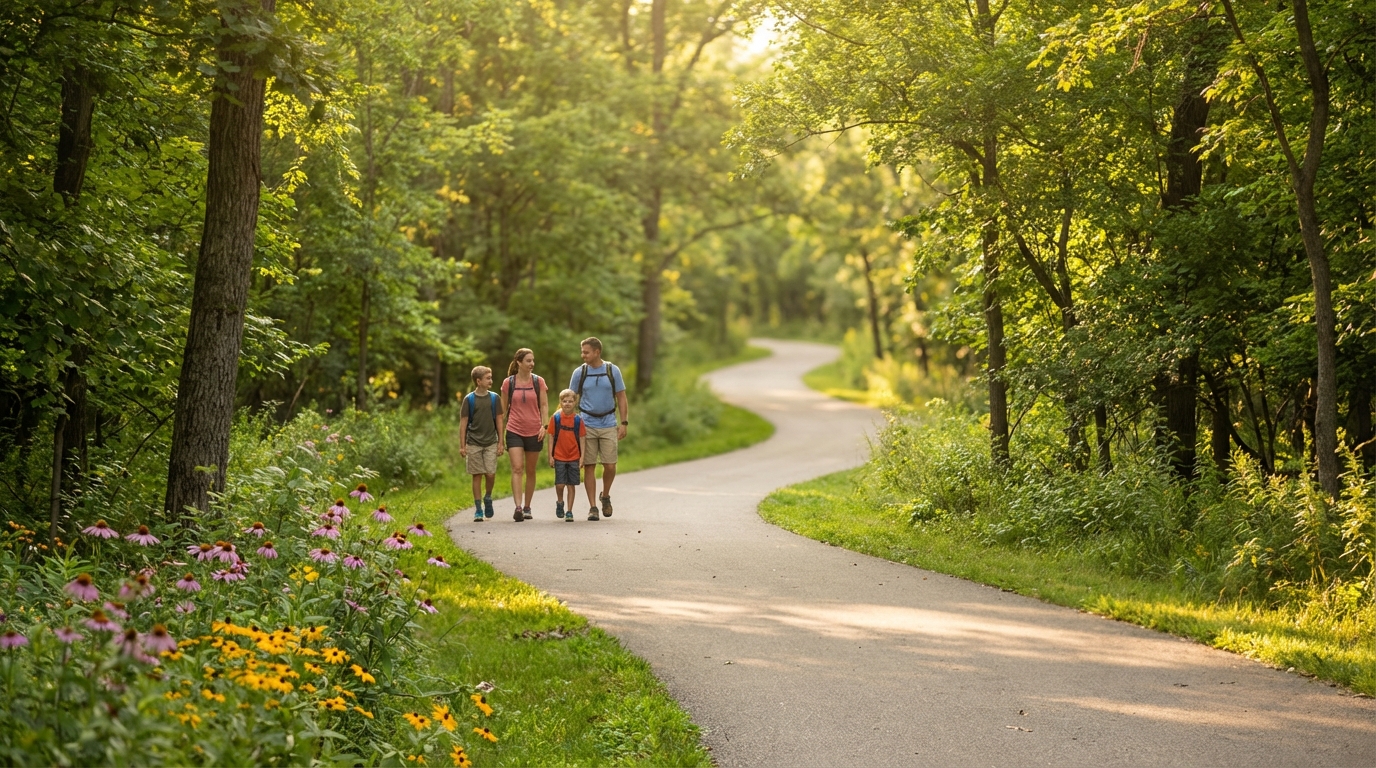

Outdoor recreation in Warren County, Ohio, delivers a $96.4 million annual economic impact, according to an economic study released in March 2026, offering campground and RV park operators a detailed look at how trail and park investments translate into measurable returns for nearby hospitality businesses. The research, which examined 2024 economic data across nearly 12,500 acres of outdoor recreation land and 124 miles of trails, provides a case study in how public recreation assets can drive visitor spending that benefits private outdoor hospitality operations positioned to capture that demand.
The $25,000 study was commissioned by the Warren County Wild Collaborative, an informal alliance of local governments, businesses, and nonprofit organizations. The Warren County Park District conducted the research in partnership with the University of Cincinnati Alpaugh Family Economics Center, with funding provided by the Warren County Park District, the cities of Mason, Springboro, and Lebanon, and Deerfield Township. The scope included publicly owned parks, trails, natural areas, and select nonprofit recreation facilities, with key assets analyzed including Caesar Creek State Park, the Great Miami River Trail, the Little Miami Scenic Trail, and local trail networks throughout the county’s municipalities and townships. Notably, the study excluded Kings Island as a commercial entertainment attraction and Warren County Sports Park as a venue not available for everyday community use, focusing instead on assets accessible for regular community recreation.
An estimated 2.8 million out-of-county visitors traveled to Warren County’s outdoor recreation areas, according to the study’s findings. These visitors spent $33.1 million on lodging, dining, retail, gas, and other amenities during their trips, representing a substantial revenue stream that flows through local hospitality businesses. For campground and RV park operators, this visitor volume underscores the value of positioning properties as gateways to major recreation assets.
For campground and RV park operators looking to capture a share of this $33.1 million in visitor spending, overnight guests typically spend significantly more than day visitors, making campgrounds and RV parks near major trail systems particularly valuable economic drivers. Operators may want to consider on-site convenience offerings such as camp stores stocked with locally sourced goods, grab-and-go food options, and outdoor gear essentials, which tend to generate impulse purchases while extending guest stays. Partnership programs with local outfitters for bike rentals, kayak shuttles, and guided experiences allow operators to earn referral revenue without major capital investment. Extended stay incentives such as weekly rate discounts encourage visitors to use properties as base camps for exploring multiple trails and parks, while premium site placement near trail access points typically commands higher nightly rates.
Warren County Park District CEO Matt Latham addressed why commercial attractions were excluded from the study, noting that visitors benefit from having multiple options during their outdoor recreation trips. “That to me is a benefit. It’s good, to me, that (visitors) have other things to do while they’re in town. That enhances their experiences,” Latham said. This observation highlights the complementary relationship between public recreation assets and private hospitality businesses, where trails and parks serve as primary draws while campgrounds, restaurants, and retail establishments capture ancillary spending.
Local outdoor recreation businesses generated $37 million from park visits, according to the study, which examined companies such as canoe liveries and bike rentals while excluding large retail stores selling outdoor merchandise. These businesses support 230 jobs and account for $9.9 million in annual wages, demonstrating the direct employment impact of recreation-related commerce. Latham stated that outdoor recreation in Warren County returns $5 for every $1 invested in public park and trail enhancements, a metric that underscores the value of continued public infrastructure development that benefits nearby outdoor hospitality businesses.
The demographic context surrounding Warren County’s outdoor recreation economy reflects broader shifts occurring in transitioning markets across the country. Warren County Commissioner David Young noted that the community has evolved substantially over recent decades. “Thirty, forty years ago Warren County was a rural county. As the county has become more urbanized, the need for more parks and recreation have gone up,” Young said. Large, dense developments were previously the exception in the county, but urbanization has driven corresponding growth in recreation demand.
For outdoor hospitality operators serving these changing demographics, adaptation is essential. As formerly rural areas become more suburban, operators may find it beneficial to adjust their offerings for guests who may be newer to camping or expect higher comfort levels. Operators might consider glamping and alternative accommodations such as cabins, yurts, and safari tents to appeal to guests wanting outdoor experiences without their own camping equipment. Reliable Wi-Fi and cell service have become baseline expectations as more guests blend remote work with recreation travel, and enhanced bathroom facilities with modern fixtures can help attract guests transitioning from hotel stays. Strong online presence, professional photography, and reputation management are essential for reaching urban and suburban demographics who frequently discover outdoor recreation through digital channels.
Family-friendly programming such as nature walks, campfire activities, and junior ranger programs appeals to suburban families seeking structured outdoor experiences for children. Meanwhile, eco-friendly infrastructure investments including solar lighting, recycling stations, and native landscaping resonate with environmentally conscious suburban demographics while often reducing long-term operational costs. Operators in Warren County and similar transitioning markets should consider auditing their facilities against suburban guest expectations and prioritizing upgrades that bridge the gap between traditional camping and the comfort levels these demographics expect.
Looking ahead, Warren County continues investing in trail infrastructure that will expand opportunities for outdoor hospitality businesses. The park district is currently conducting a Western Warren County Multi-use Trail study examining connections between the county’s three largest cities: Springboro, Lebanon, and Mason. This summer, the park district plans to study the possibility of constructing a walking tunnel under State Route 741 to connect Armco Park with the Warren County Sports Complex, building on strategic investments such as the 2008 cooperative purchase of Armco Park from AK Steel by the Warren County Commissioners, the Warren County Park District, Turtlecreek Township, Otterbein Senior Life, and the State of Ohio.
Latham emphasized the potential of regional trail connectivity, noting that major loops of 100 miles or more of connected trails are an effective strategy for attracting outside visitors and investors. “If we can link it all up, the skies the limit,” he said, discussing the Western Warren County Multi-use Trail study and its implications for regional visitation.
For campground, RV park, and outdoor hospitality operators, this type of regional trail connectivity represents long-term infrastructure investment that expands the visitor base and creates multiple entry points for guests to access recreation assets. Properties positioned along these future corridors may benefit from increased traffic and visibility as the network grows, making proximity to planned trail development an increasingly important consideration for operators evaluating expansion opportunities or site improvements. The documented $96.4 million economic impact demonstrates that demand exists, and the five-to-one return on public investment suggests public infrastructure will continue expanding, bringing new visitors that well-positioned outdoor hospitality businesses can capture.
