

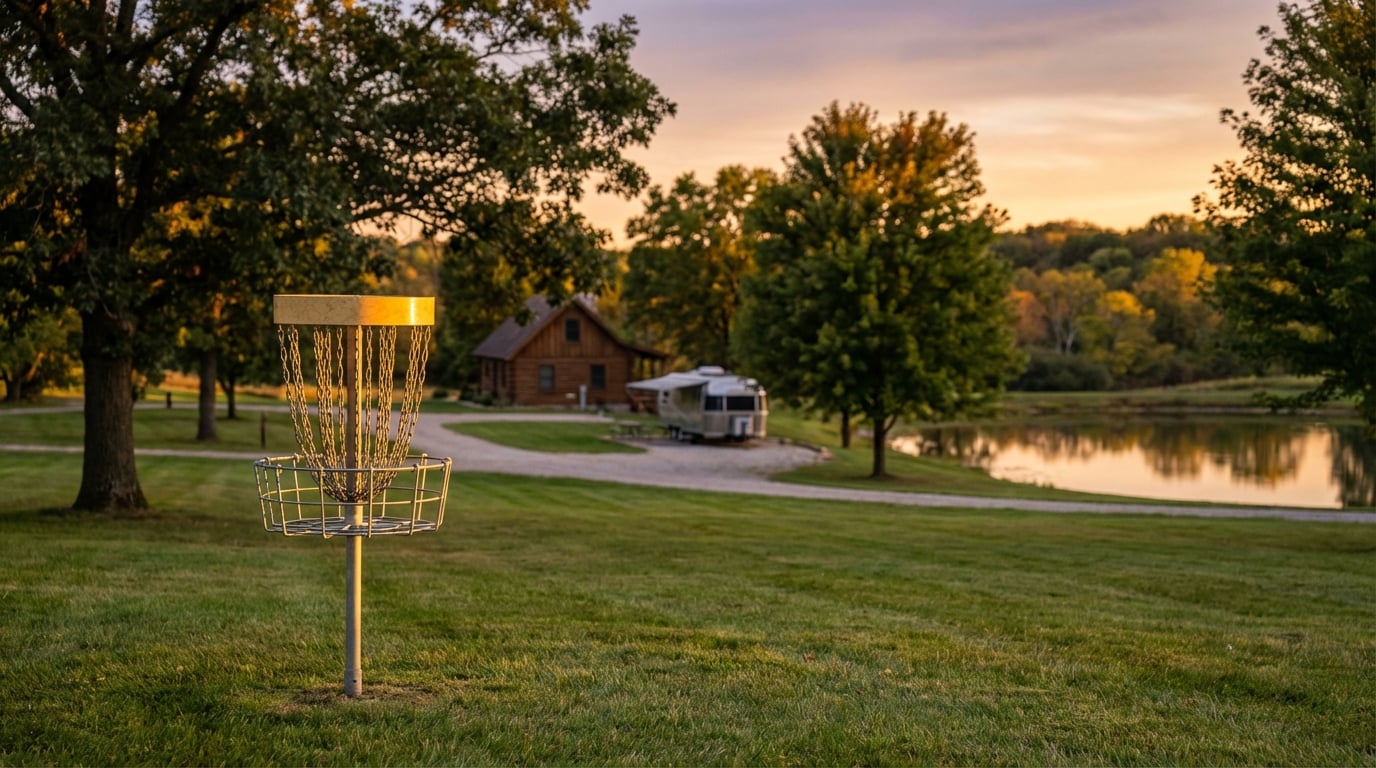

A Kansas disc golf destination is expanding its lodging capacity after securing nearly $82,000 in state tourism funding, a development that illustrates how outdoor hospitality operators can leverage public grant programs to grow their niche recreation properties.
The Kansas Department of Commerce awarded the Tourism Attraction Development Grant to Dynamic Brewing, which operates as Champions Landing in Emporia. The grant will fund enhancements and increased short-term lodging availability. The grant covers 40 percent of total project costs, and the development relies on no local municipal funding.
The expansion includes construction of four tiny home or lofted cabins, along with four RV pads. According to Rusco, the tiny home cabins will be positioned near the property’s pond, while the RV accommodations will be situated between the pond and maintenance equipment. This strategic placement keeps all lodging within immediate reach of the disc golf course itself.
The Champions Landing project reflects a broader trend: Outdoor hospitality properties increasingly find success by anchoring their business model around a specific recreational niche rather than positioning as generic campgrounds. This destination-based development approach allows operators to attract dedicated enthusiast communities who travel specifically for their passion and tend to stay longer and spend more during their visits. By locating accommodations within easy access of the primary attraction, properties reduce friction for guests and create a more cohesive experience that encourages return visits and referrals.
The varied lodging tiers at Champions Landing, from RV pads to premium cabins, demonstrate another widely accepted best practice. Offering multiple accommodation options allows properties to capture different market segments within the same enthusiast community, from budget-conscious travelers comfortable in their own rigs to guests seeking more upscale lodging experiences.
Alongside the lodging additions, the grant partially funds significant upgrades to the existing disc golf course. Improvements include enhanced tee pads and fairways, new landscaping throughout the property, and installation of a rock wall feature. These course upgrades complement the lodging investment by ensuring the primary attraction remains competitive and appealing to visiting players.
Properties that successfully pair niche recreation with lodging often become known as destination facilities within their enthusiast community. This status generates organic marketing through word-of-mouth and social media sharing among players who travel the regional and national disc golf circuit. Building relationships with organizations that govern niche sports can also lead to event hosting opportunities that fill occupancy during shoulder seasons when casual tourism typically declines.
The funding structure of the Champions Landing project offers a template for other outdoor hospitality operators considering expansion. Many campground and RV park owners overlook state and regional tourism grant programs as viable funding sources, yet these programs exist in most states and actively seek projects that drive visitor spending and overnight stays.
For operators considering similar applications, grant programs typically favor projects demonstrating clear tourism impact, such as increased lodging capacity or attraction of out-of-region guests. Applications showing private investment commitment alongside grant requests tend to perform better, as funding agencies want to see operator commitment to the project. The Champions Landing structure, requiring no local municipal funding, represents a model that gives operators independence from local government budget cycles and political considerations.
Operators interested in similar funding should research their own state tourism development grant programs through state commerce or economic development agencies. Building a track record of successful grant execution can position properties favorably for future funding opportunities as they continue to grow.
Construction on all three project components is proceeding simultaneously, with Rusco targeting Memorial Day as the completion date. The timing is intentional, aiming to have the new RV pads, cabins, and course upgrades fully operational for Emporia’s largest annual tourism events.
This construction timeline reflects an understanding that niche recreation properties should align major improvements with peak event seasons to maximize return on investment. Having expanded capacity ready for high-traffic periods ensures operators can immediately benefit from their investment. The Champions Landing model demonstrates how combining state tourism funding with destination-based development can transform a recreational property into a regional tourism asset, offering a viable path forward for outdoor hospitality operators seeking to differentiate their businesses in an increasingly competitive market.
