

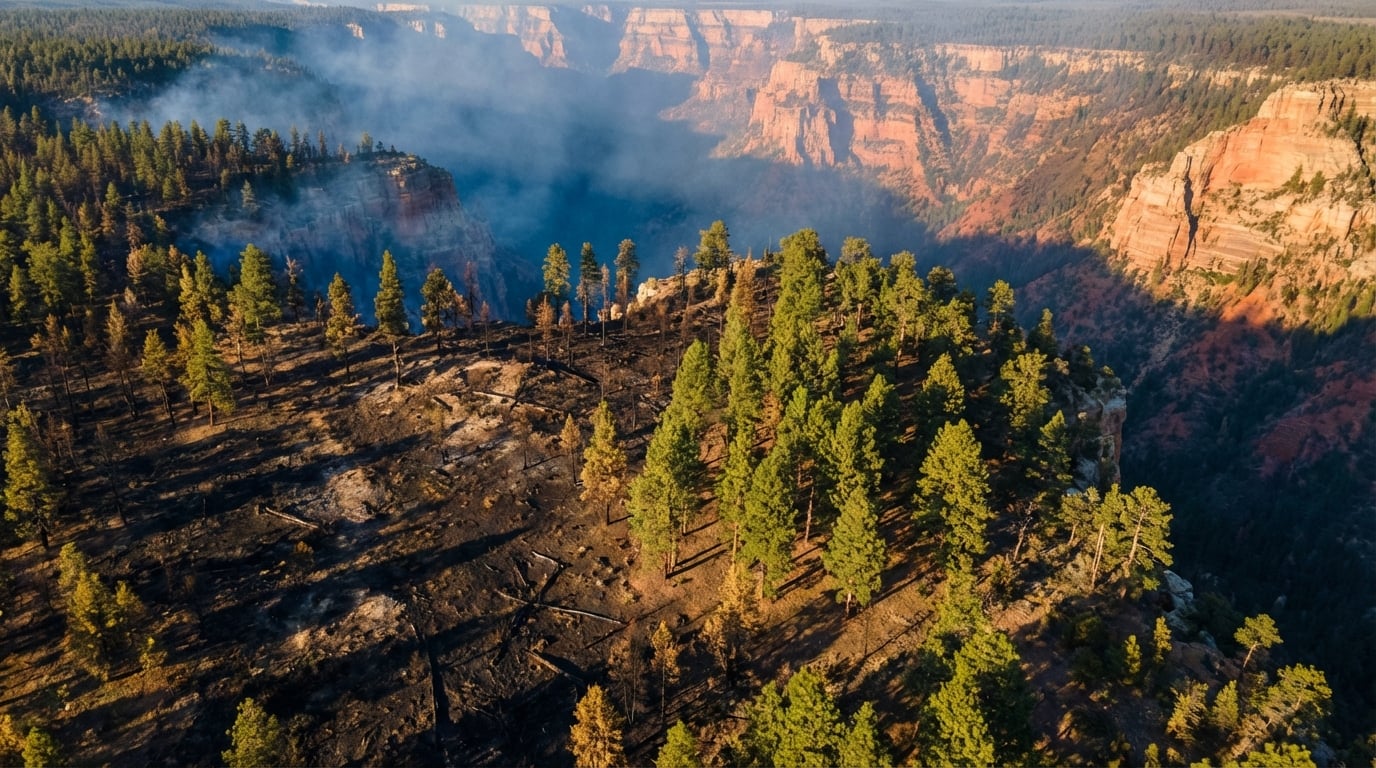

The National Park Service has confirmed that the North Rim Campground at Grand Canyon National Park will not open for the 2026 season, leaving visitors without overnight lodging options within park boundaries for the entire year. The extended closure stems from catastrophic infrastructure damage caused by the Dragon Bravo Fire, which swept through the North Rim during the summer of 2025. Reservations for the campground will not be released, and park officials have indicated that demolition and stabilization work in the affected area makes conditions unsafe for overnight visitors.
Aerial reconnaissance conducted on July 12, 2025, confirmed the destruction of 11 residences in the NPS Administration Area, multiple office buildings, and water treatment facilities. According to the park’s official status page, a subsequent aerial assessment on July 13, 2025, confirmed the destruction of the historic Grand Canyon Lodge, the North Rim Visitor Center, and numerous historic cabins. Several structures survived the blaze, including the General Store, campground facilities, the gas station, and some cabins and housing units. However, ongoing demolition and stabilization efforts have rendered the entire developed area unsuitable for overnight guests throughout the coming season.
The Dragon Bravo Fire ignited from a lightning strike on July 4, 2025, and was initially managed under a confine and contain suppression strategy with approximately 110 personnel assigned to the incident. Conditions deteriorated rapidly on July 10, 2025, when the nearby White Sage Fire threatened Highway 67 access, prompting the evacuation of 500 visitors from the North Rim. The following day proved catastrophic when unpredictable shifting winds at 3:30 p.m. caused the Dragon Bravo Fire to breach containment lines and spread rapidly toward critical infrastructure. NPS and concessions staff received evacuation orders as flames advanced on housing and administrative buildings. Aerial damage assessments on July 12, 2025, revealed the extent of destruction, and a chlorine gas leak at the water treatment plant forced immediate evacuation of Phantom Ranch and the inner canyon corridor.
Beyond the immediate impact on park operations, the destruction documented at the North Rim offers critical lessons for private outdoor hospitality operators in fire-prone regions across the West. The loss of the Grand Canyon Lodge and administrative buildings underscores the importance of wildfire preparedness as a core operational concern for campgrounds, RV parks, and glamping resorts. Creating and maintaining defensible space around structures remains fundamental, including clearing vegetation and combustible materials within designated perimeters around buildings, propane tanks, and high-occupancy guest areas. Fire-resistant building materials such as metal roofing, fire-rated siding, and ember-resistant vent covers have become increasingly common specifications for properties operating in wildland-urban interface zones.
Comprehensive evacuation plans with clearly marked routes and established communication protocols are essential for any property in fire-risk territory. Digital guest communication platforms and mass texting capabilities are now standard features in many campground management software solutions, enabling rapid alerts about evacuation orders, air quality advisories, or access restrictions. Annual insurance coverage reviews ensure policies reflect current rebuilding costs and include adequate business interruption protection, a consideration that becomes especially relevant when examining the scale of recovery required at the North Rim.
Park officials are implementing an adaptive approach to reopen sections of the North Rim for limited day-use access during the 2026 season. The tentative target date for popular points of interest, including the North Kaibab Trail and scenic overlooks, is May 15, 2026. This timeline remains contingent on weather conditions and completion of safety assessments. The guiding principle for the season, according to park management, centers on opening what they can, where they can, when they can, while maintaining primary focus on visitor safety and resource protection.
Numerous trails remain closed due to fire impacts and seasonal conditions. The North Kaibab Trail north of the Ribbon Falls junction to the North Kaibab Trailhead is inaccessible, as are the Widforss Trail, Transept Trail, Bridle Path, Ken Patrick Trail, Ken Patrick Trail South of Cape Royal Road, Uncle Jim Loop, Cape Royal Trail, Cliff Spring Trail, Cape Final Trail, and Roosevelt Point Trail. The Arizona Trail through the park also remains closed while assessments continue. Currently accessible areas include Phantom Ranch, Bright Angel Campground, the North Kaibab Trail from Phantom Ranch to Ribbon Falls, the South Kaibab Trail to Phantom Ranch, and portions of the Bright Angel Trail and Tonto Trail.
Recovery efforts are further complicated by the ongoing $208 million Transcanyon Waterline rehabilitation project. Construction crews are replacing the aging water delivery system along the North Kaibab Trail between Cottonwood Campground and the Roaring Springs Pumphouse. A July 17, 2025, post-fire assessment determined that the North Rim water pipeline and water treatment plant sustained severe damage, adding urgency to infrastructure repairs already underway.
The Dragon Bravo Fire impacted several key watersheds draining into the Colorado River, including House Rock Wash, North and South Canyons, Buck Farm Canyon, Nankoweap Creek, Kwagunt Creek, Malgosa, Awatubi, 60-Mile, Clear Creek, Bright Angel Creek, Crystal Creek, and Tuna Creek. Some of these drainages exceed 13 miles in length. Burned areas face increased risk of flash floods and debris flows during monsoon season and heavy precipitation events, with flooding capable of occurring within minutes of heavy rainfall near the burn scar. Debris flows consisting of water, ash, mud, rocks, and trees can damage infrastructure miles downstream.
With no overnight stays permitted within North Rim park boundaries for 2026, visitors are being directed to gateway communities including Jacob Lake, Kanab, Fredonia, and Page for accommodations. This situation has historically driven increased booking inquiries and occupancy for private campgrounds, RV parks, and glamping properties within reasonable driving distance of affected public lands. Industry observers note that operators typically update online listings and booking platforms to communicate distance to impacted destinations and add relevant keywords to improve discoverability among displaced travelers searching for alternatives.
In response to similar extended closures, outdoor hospitality operators have implemented various approaches to accommodate redirected visitors. Given destination uncertainty, some properties offer reasonable cancellation windows or date modifications to reduce booking hesitation among visitors planning trips to affected areas. Properties have partnered with local outfitters, tour operators, and day-use shuttle services to offer packaged experiences, bundling accommodations with guided day trips or activity rentals. When overnight options within a destination are unavailable, visitors often extend gateway property stays to accommodate multiple day trips, a pattern that has led some operators to adjust site availability for multi-night bookings and minimum stay requirements.
Park staff managed to reopen key areas for limited visitor access between October 1 and November 14, 2025, including Cape Royal Road, Point Imperial, and the Highway 67 corridor before winter weather constraints forced an early seasonal closure. Arizona Department of Transportation reopened Highway 67 from Jacob Lake to Kaibab Lodge on August 29, 2025, though the North Rim south of mile marker 605 remained closed. A multi-agency Department of Interior Burned Area Emergency Response Team began assessing fire impacts on NPS and Bureau of Land Management lands on August 21, 2025, completing preliminary post-fire assessments and providing recommendations to park management by September 2, 2025. For private outdoor hospitality operators in gateway regions, the 2026 season presents both operational considerations for wildfire preparedness and potential increased visitor traffic, with conditions remaining subject to change based on weather and ongoing evaluations.
