

Flagstaff Mountain RV & Campground has officially opened along historic Route 66 in Flagstaff, Arizona, marking the completion of a development project that required excavating and repurposing nearly 18 million tons of red rock entirely on-site. The four-acre property, situated below the southwest edge of McMillan Mesa, features 33 full-hookup RV sites designed for year-round operation. Longtime Flagstaff residents Ronda Stump, a retired escrow officer who specialized in Northern Arizona hospitality properties, and her son Arron Bailey, formerly the owner of Randy’s Downtown Garage, led the development near downtown Flagstaff.
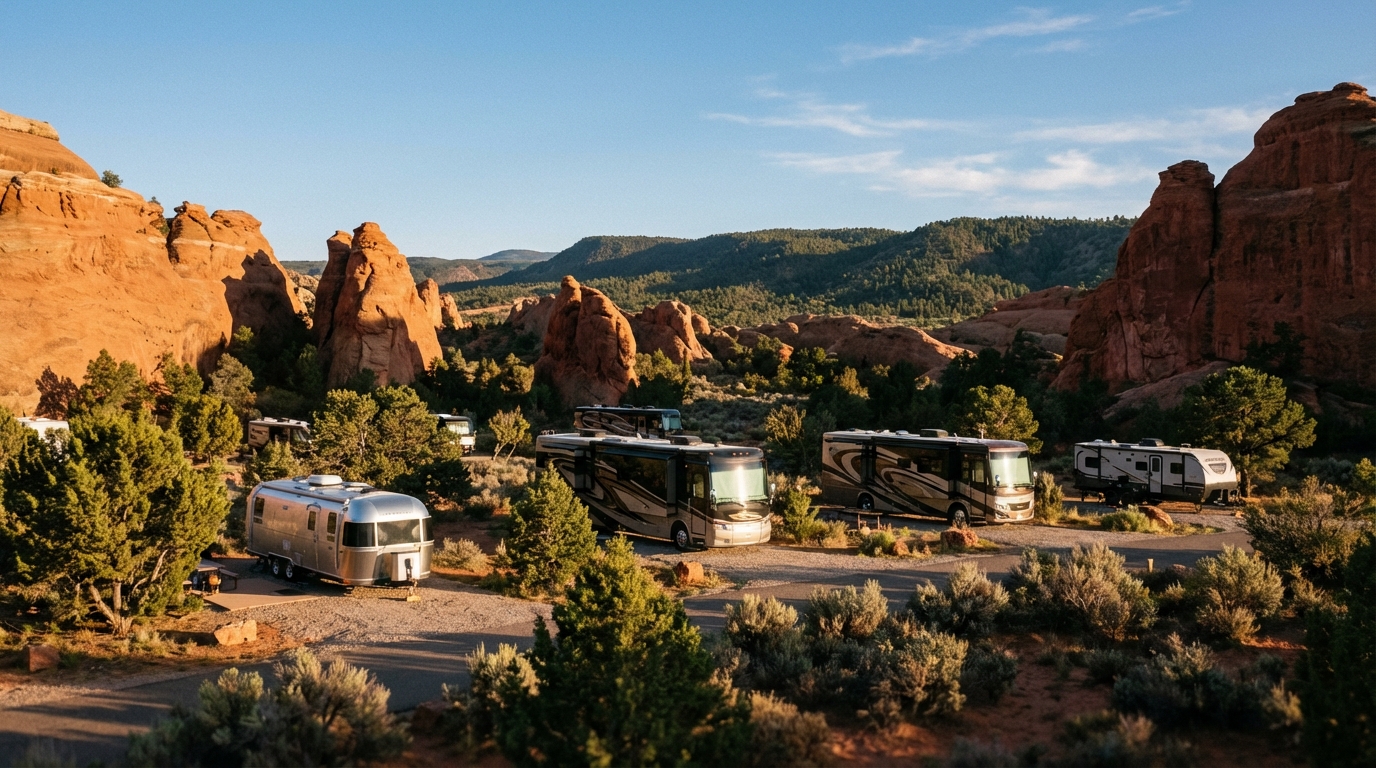
The previously undeveloped parcel sits behind the former Muffler Magic property, and the developers deliberately chose a horizontal, low-density hospitality model over traditional multi-story construction. “We found this property and didn’t want to go vertical,” said Ronda Stump, co-developer of Flagstaff Mountain RV & Campground. Many of the RV sites are positioned against natural red rock sandstone walls that serve as buffers against traffic noise from the nearby highway, allowing the development to integrate with the surrounding landscape rather than dominate it.
For outdoor hospitality developers considering similar projects, this approach reflects a growing preference for balancing construction costs with environmental responsibility. Working with existing topography rather than against it typically results in better drainage outcomes and reduced erosion over time. Sustainable construction practices are increasingly valued by guests, particularly younger travelers who prioritize environmentally conscious businesses when making booking decisions. Operators considering similar projects should understand that these methods can differentiate a property in an increasingly competitive market.
The excavation effort stands as one of the project’s notable elements. Contractors 108 Excavating and Highland Excavating performed the removal, with all excavated material reused entirely on-site for backfill supporting campground pads, road loops, and landscaping. “The majority of what you see here came from this ground. The overall footprint stays relatively small and we cut very few trees,” said Arron Bailey, co-developer of the campground. Only approximately 10 percent of landscaping material was imported, primarily from the Verde Valley, with Agassiz Landscape Group incorporating the excavated red rock into the property’s design and planting native trees.
For campground developers and RV park operators weighing similar approaches, reusing excavated materials for road base, drainage features, and pad construction can significantly reduce hauling costs and material procurement expenses. Keeping heavy truck traffic off public roads during construction minimizes community disruption and can expedite permitting processes with local authorities. Natural stone and native materials often require less long-term maintenance than imported products because they are already adapted to local climate conditions. Many municipalities offer expedited permitting or reduced fees for projects demonstrating commitment to waste reduction, making soil testing and engineering assessments essential before repurposing excavated materials.
The site carries historical significance that connects directly to the excavation work. Located near the historic Arizona Sandstone Co. quarry, which supplied the “Arizona Red” sandstone used in many downtown Flagstaff buildings, the property continues a legacy of working with the region’s distinctive geology. Flagstaff Fire Department Station 2 now occupies part of the former quarry site, and the campground sits within about a mile of historic downtown. Mogollon Engineering and Surveying confirmed that stormwater runoff patterns will remain consistent with pre-development conditions, while Architectural Design Studio, led by Anne Mead, handled design work.
Year-round operation required careful infrastructure planning in Northern Arizona’s challenging climate. High-efficiency LED lighting complies with Flagstaff’s strict Dark Sky regulations, and electric radiant heating was selected instead of natural gas systems. The developers chose concrete paving to avoid the repeated petroleum-based sealing required with asphalt and installed infrastructure to accommodate future solar energy expansion. “All water lines are underground so we can operate through winter,” said Stump, explaining how the buried utilities prevent freezing during the region’s cold months. The on-site convenience store and bar are housed in the repurposed Muffler Magic building, preserving the embodied energy in existing materials while demonstrating adaptive reuse practices that outdoor hospitality operators can consider for their own properties.
Local contractor involvement was central to the project’s execution. Barmore Flooring and Design, JAMZ Electric, Foundations Concrete Construction, and Agassiz Landscape Group all contributed to the development. “Our contractors and subcontractors are 100% local. These are people I grew up with here,” said Bailey, whose family moved to Flagstaff in the 1970s. This commitment to local sourcing extended throughout every phase of construction.
The campground’s amenity strategy reflects an increasingly popular revenue diversification approach in outdoor hospitality. The property holds an Arizona Series 7 liquor license allowing beer and wine sales to both registered guests and the general public, with an on-site bar and patio area featuring a 6-foot gas firepit. Single Speed Coffee Roasters provides coffee service, while Jitters Lunchbox offers sandwiches, espresso drinks, and light fare. Additional amenities include a planned dog park, electric bike rentals, and high-speed fiber Wi-Fi designed to support digital nomads and remote workers.
The Flagstaff property’s decision to welcome non-guests illustrates a broader industry shift that operators may want to consider for their own developments. Opening select amenities to non-guests has become an increasingly popular revenue diversification strategy in outdoor hospitality. Creating public-facing amenities such as cafes, bars, or event spaces can generate income during shoulder seasons when overnight occupancy typically declines. Partnering with established local vendors rather than operating all food and beverage services in-house often reduces staffing complexity and startup costs while providing guests with authentic local experiences. Obtaining appropriate liquor licensing can significantly increase average per-guest spending, though operators must factor in insurance requirements and responsible service training. Properties that position themselves as community gathering spaces often benefit from word-of-mouth marketing and repeat local visitation, though successful implementations require careful traffic flow planning and signage to maintain the quality experience for overnight guests.
Digital nomad amenities such as high-speed internet and comfortable workspace areas address a growing market segment that often books extended stays during traditionally slower periods. The fiber connectivity already installed at Flagstaff Mountain RV & Campground positions the property to capture this demographic while supporting the concierge-style promotion of local businesses that the developers have emphasized.
The project reflects the developers’ deep roots in the community and their vision for how visitors should experience the region. “The idea is to support local whenever possible. We want this to be a hub for exploring Flagstaff – hiking, skiing, the Grand Canyon – while keeping tourism dollars circulating locally,” said Stump. The campground is designed to serve as a basecamp that connects tourists with the surrounding landscape and local economy. “We’re from Flagstaff. Our family moved here in the 1970s. This is home, and we want visitors to experience it the way locals do,” Stump added. The public is welcome to purchase beverages and food at the on-site bar and patio, and the campground is now open and operational.
