

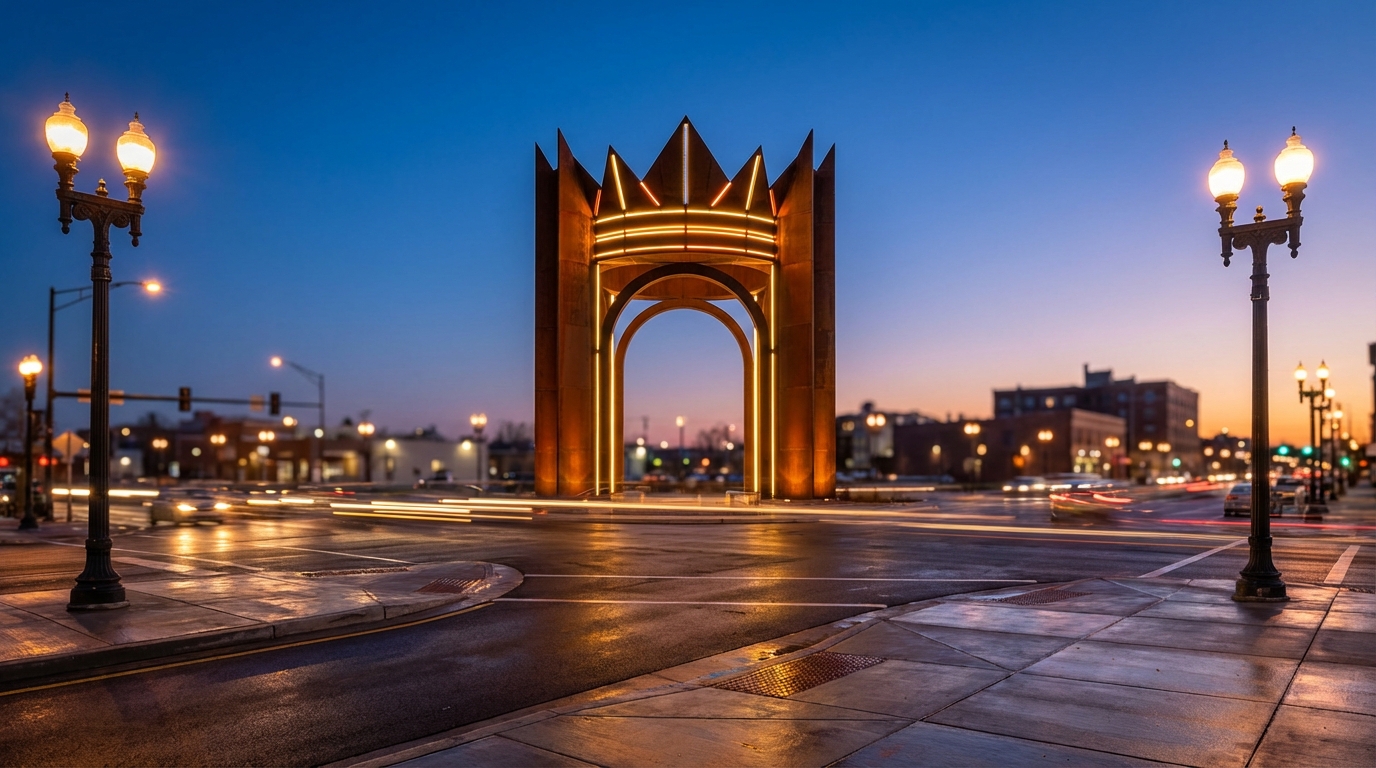

Springfield, Missouri’s city council has unanimously approved $267,000 in state appropriation funds for street and right-of-way improvements surrounding the Queen’s Gate 66 monument, a 20-foot-tall illuminated sculpture set to welcome visitors at the intersection of St. Louis Street and Glenstone Avenue. The infrastructure investment signals a major tourism catalyst for the Route 66 corridor as the historic highway approaches its centennial celebration, creating strategic opportunities for campgrounds and RV parks positioned along the Mother Road to capture heritage-focused travelers.
The monument, officially titled Queen’s Gate 66, features a stylized crown design paying homage to Springfield’s nickname as the “Queen City of the Ozarks.” Designed by Kansas City-based Farris Wheel Studios and Amie Jacobsen, the sculpture will sit on a 2-foot plinth and include a central archway marked “Birthplace of Route 66.” The illuminated gateway is intended to create a dramatic sense of arrival for tourists traveling the legendary highway, integrating the city’s local identity with its national historical significance as the place where Route 66 was officially named.
“About a year and a half ago, we started talking about the visitor experience on Route 66 in Springfield, and what that led to is a conversation about a sense of arrival into Springfield,” said Mark Hecquet, Visit Springfield’s CEO, describing the vision behind the monument project.
Heritage tourism consistently ranks among the strongest motivators for RV travel, with historic routes like Route 66 serving as bucket-list destinations for a significant portion of the RV-owning demographic. Classic car enthusiasts and history buffs overlap substantially with the RV community, as many vintage vehicle collectors travel with motorhomes or trailers to transport and display their cars at shows. Campground operators along or near Route 66 who market specifically to this crossover audience—offering amenities like secure trailer parking, vehicle washing stations, or car show shuttle services—may find themselves particularly well-positioned during the celebration.
The State of Missouri allocated $1 million to Visit Springfield to manage the project, with the $267,000 appropriation transferring a portion of these funds to the city specifically for street and right-of-way improvements. These infrastructure enhancements are designed to ensure long-term durability and proper integration into existing infrastructure ahead of the monument’s installation. A public dedication ceremony is scheduled for 11 a.m. on Friday, May 1, as part of the National Route 66 Centennial Kickoff Celebration running April 30 through May 3.
State Senator Lincoln Hough helped secure the state appropriations, while local business owner Gordon Elliott contributed to the project through a private land arrangement. Elliott, who owns the nearby Best Western Route 66 Rail Haven, provided right-of-way access and additional parking at a property adjacent to his historic landmark hotel to accommodate visitors wanting to photograph the monument.
The Elliott arrangement reflects a model of public-private partnership with direct applications for outdoor hospitality development: such partnerships can serve both tourism goals and private business interests simultaneously. Property owners near attractions can negotiate land use agreements that serve mutual objectives. Campground operators with undeveloped adjacent parcels may find local governments receptive to infrastructure cost-sharing when projects expand visitor capacity in their regions.
Many states offer tourism development funds that can support private hospitality infrastructure when it aligns with broader destination marketing goals. Operators who engage with local convention and visitors bureaus often gain early awareness of such funding opportunities before they become widely known. The broader $1 million state allocation managed by Visit Springfield suggests additional funding streams may exist for complementary projects along the Route 66 corridor.
Properties anticipating heritage tourism influxes have pursued specific operational preparations in similar situations. Theming and branding alignment with local historical elements—such as vintage-style decor or photo opportunities referencing surrounding historical context—tends to create stronger emotional connections with heritage-focused travelers. Extended stay incentives have shown appeal with this demographic, as heritage tourists often prefer slower-paced travel, making them potential candidates for weekly rate promotions.
Digital visibility optimization represents another common preparation step. Updating online listings with keywords tied to centennial events helps properties appear in searches from travelers planning Route 66 trips. Event-ready infrastructure, including adequate electrical capacity for modern RVs, expanded pull-through sites for larger rigs common among retiree travelers, and overflow parking arrangements, addresses peak demand periods.
Partnership development with local tourism bureaus allows campgrounds to be included in official itineraries and promotional materials distributed to incoming tourists. Tourism bureaus frequently seek private partners to share costs and content for destination marketing campaigns, and operators who contribute compelling visual content or guest testimonials may receive prominent placement in official tourism materials.
Visit Springfield has additional plans for generating interest in the city’s Route 66 section beyond the gateway monument. These include a new birthplace plaza located where the first telegram requesting Route 66 was sent, plus Route 66 shield sculptures throughout the city. Outdoor hospitality operators anywhere along Route 66—not just in Springfield—have a strategic window to position themselves as basecamp destinations for centennial visitors who will be traveling the entire corridor.
The collaborative model demonstrated in Springfield, involving state legislators, tourism bureaus, municipal government, and private landowners aligning around a shared destination enhancement goal, offers a replicable framework for outdoor hospitality businesses seeking to participate in similar tourism development initiatives across their own regions.
