

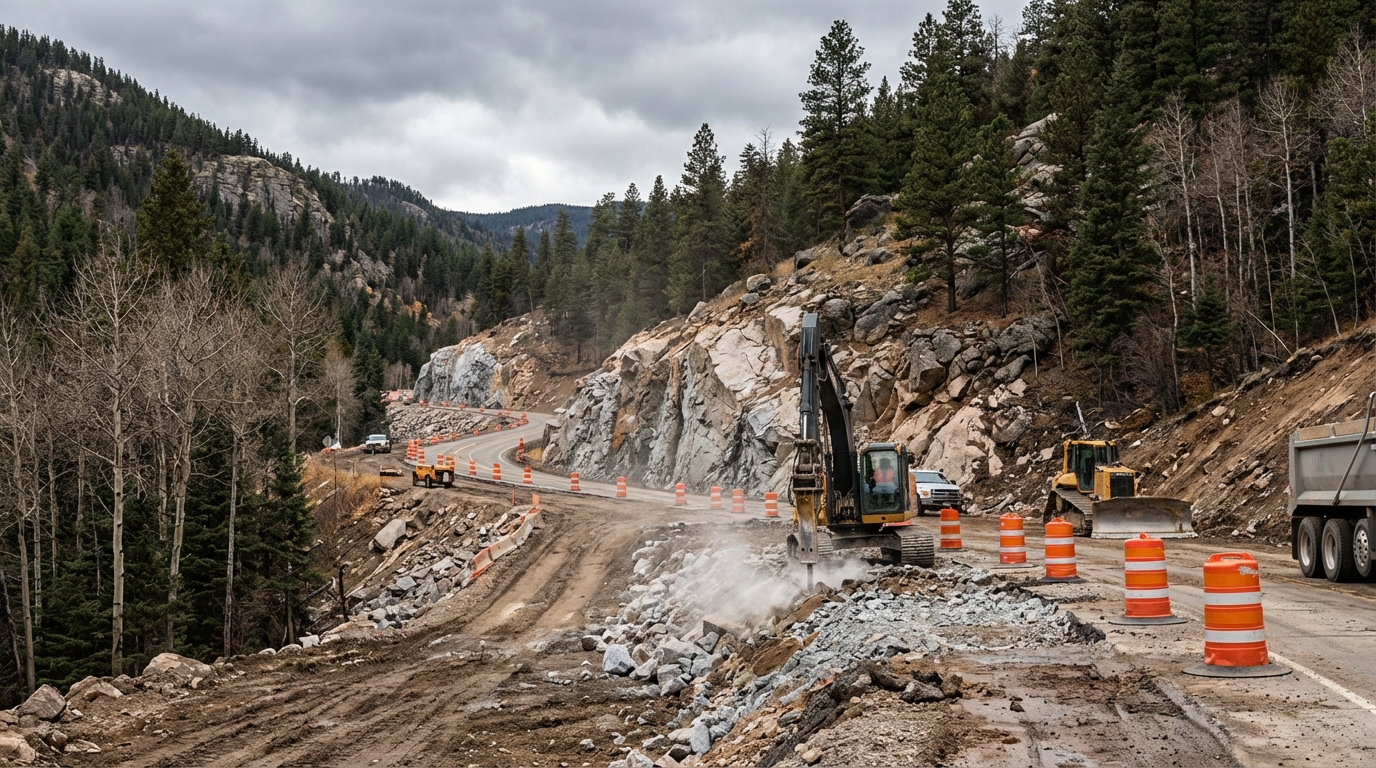

The $72 million reconstruction of U.S. 385 through South Dakota’s central Black Hills remains on schedule for its 2027 completion, with engineers reporting smooth progress on the second major phase of the three-year project that began in 2024. The project to widen and enhance safety along a 15-mile stretch from Sheridan Lake to the Pennington-Lawrence county line directly affects access to campgrounds, RV parks, and tourism destinations throughout the region, as this narrow, winding route serves as the only major north-south highway through the heart of the Black Hills, according to a recent Associated Press report.
Tim Wicks, South Dakota Department of Transportation engineer overseeing the project, confirmed that work has proceeded without major delays or worker injuries. “As of now, we are on schedule and very happy with the progress. We’ve had some additional costs that often happen with these kinds of projects, but nothing major,” Wicks said. A full road closure designated as Closure E currently runs from the south end of Pactola Dam to Custer Gulch Road, having begun on Oct. 20, 2025, with a scheduled end date of March 6, 2026. Local access to Victoria Lake Road remains available, though through traffic must navigate a 40-mile detour through Rapid City. Construction paused from Dec. 19, 2025, through Jan. 4, 2026, for a holiday break, but the closure remained in effect throughout that period.
These extended closures and detours present real challenges for outdoor hospitality businesses in the region, but proactive guest communication can help operators mitigate booking losses. Updating website homepages with clear construction status banners and alternative route information helps guests plan their trips with confidence rather than canceling out of uncertainty. Pre-arrival emails containing detailed navigation instructions, including GPS coordinates for alternative routes, reduce guest anxiety and last-minute cancellations. Training reservation staff to confidently explain detour routes and estimated travel times can convert uncertain callers into confirmed bookings. The SDDOT maintains a dedicated website at US-385.com and offers text updates that operators can link to in their own guest communications, ensuring accuracy without creating additional administrative burden.
The safety concerns driving this project are evident when examining crash statistics for the stretch being rebuilt. The overall crash rate on this highway segment is more than double the state average, with data from 2018 through 2022 revealing 187 crashes, four fatalities, and 57 injuries over that five-year period. One-third of those wrecks and most of the fatalities occurred when motorists left the roadway, a danger compounded by spots where almost no shoulder exists while the road closely abuts rock walls or rims significant drop-offs. The SDDOT has set a goal to reduce the crash rate on this segment by 50 percent through several key improvements: expanding shoulders from an average of two feet to eight feet, smoothing sharp curves to meet current design standards, adding turn lanes to improve traffic flow, and softening off-road slopes. The shoulder expansion alone is projected to reduce run-off-the-road crashes by 43 percent.
“The shoulders are wider and the slopes are gentler in case you do run off the road. We’re not going to stop every accident, but you’ll have a better chance to avoid it or it will become much less severe,” Wicks said, describing the safety improvements visible on the completed section north of Pactola Reservoir to the Lawrence County line.
The mountainous terrain presents extraordinary construction challenges that explain why full road closures are necessary. Rock blasting and the removal of giant boulders represent the most challenging and labor-intensive components of the project, with the landscape making temporary bypasses impossible. A process called pioneering requires workers to clear trees and rocks to build paths to ridge tops before removal can begin. “You don’t just fly up there and land on the top. You have to build a road to get there,” Wicks explained. The work must begin at the top of ridges for critical safety reasons. “Otherwise, you would undermine the surface and it would all land on top of you,” Wicks added, describing the avalanche risks that would result from starting at the bottom. Ground-level excavators then safely chip away at edges to create space. Oftedal Construction of Miles City, Montana, serves as the contractor, with current work within Closure E including planned rock blasts, culvert excavation and replacement, and roadway grading. Additional grading continues between Sheridan Lake Road and McCurdy Gulch Road outside the closure area, with the winter road surface consisting of pavement, blotter, and gravel.
The construction has created transportation challenges for residents, schools, and emergency services throughout the region. Kristen Kilcoin, owner and operator of Three Forks Campground located at the intersection of U.S. highways 385 and 16 just south of Hill City, has experienced a slight reduction in patrons during the past two tourism seasons. “Some tourists were afraid to use the road because it was hit-or-miss whether it would be closed or if they would hit delays from a pilot car,” Kilcoin said.
Kilcoin’s experience reflects the uncertainty many guests feel when planning trips to construction-affected areas, but operators facing similar situations can implement several strategies to maintain guest confidence. Maintaining active social media updates during construction periods demonstrates transparency and builds trust, while adding a dedicated construction updates page to property websites gives guests a single resource for current conditions. Implementing flexible cancellation policies during known closure periods encourages bookings from hesitant travelers who might otherwise choose different destinations. Offering modest discounts or value-adds during construction seasons acknowledges guest inconvenience while maintaining occupancy rates. Coordinating with local tourism boards ensures accurate directional signage along detour routes, and providing downloadable PDF maps with clearly marked alternative routes gives guests tangible navigation resources. Many locals are aware of work-around routes to avoid long delays of posted detours, and operators can share these insights with guests.
Three Forks Campground has discovered an unexpected revenue opportunity by hosting U.S. 385 construction workers, providing a significant off-season revenue boost. This represents a model that other outdoor hospitality operators can replicate. Multi-year infrastructure projects create predictable demand for temporary workforce housing, and RV parks and campgrounds with full hookups, reliable Wi-Fi, and laundry facilities align well with the needs of traveling construction crews who may stay for weeks or months at a time. Properties that offer weekly or monthly rate structures become more attractive to construction contractors managing project budgets, and reaching out directly to general contractors awarded major infrastructure projects introduces properties as lodging options early in planning. Building relationships with project managers during initial stays often leads to referrals for future regional projects, and the US 385 project runs through 2027, meaning operators still have time to capture remaining workforce lodging demand. Operators pursuing this opportunity should consider establishing clear policies for work vehicles, equipment storage, and early departure times, while creating designated areas for contractor parking separate from recreational guest areas. Properties should also ensure robust electrical systems and water pressure can accommodate extended-stay utility usage, and offering grab-and-go breakfast options or partnering with local restaurants for meal delivery addresses the early work schedules common among construction crews.
A major goal for 2026 centers on having the road fully open to traffic with smooth surfaces and a typical 55 mph speed limit during the annual Sturgis Motorcycle Rally in early August. “That’s still weather-dependent, and issues do pop up. But it should be completely free-flowing traffic during the rally,” Wicks said. During the 2024 rally, U.S. 385 was open but the road surface was uneven and gravelly in spots, which increased the risk of motorcycles sliding. The bulk of road construction and rebuilding is anticipated to be completed in 2026, with only final road surfacing expected in 2027.
The highway serves as a critical corridor for regional tourism. U.S. 385 runs from Lead-Deadwood on the north to the Nebraska state line on the south, providing access to Hill City, Custer, and Hot Springs while serving as a popular drive for Sturgis Motorcycle Rally attendees. The route enables access to Mount Rushmore National Memorial, Crazy Horse Memorial, and Custer State Park, helping fuel a regional tourism industry that brought nearly $2 billion in revenue to South Dakota in 2024 according to the reconstruction project overview.
Local business owners and residents who have seen completed sections of the highway are encouraged by the improvements. “It’s going to be really nice, and safer for people driving it. There’s a couple places where you don’t even recognize it is the same road,” Kilcoin said. The completed section north of Pactola Reservoir to the Lawrence County line demonstrates what the finished highway will look like throughout the corridor. As Wicks summarized the entire undertaking: “It’s all being done for safety.” The SDDOT continues to provide updates through its dedicated website and text notification system, resources that outdoor hospitality operators can share with guests planning visits to this premier tourism destination.
