

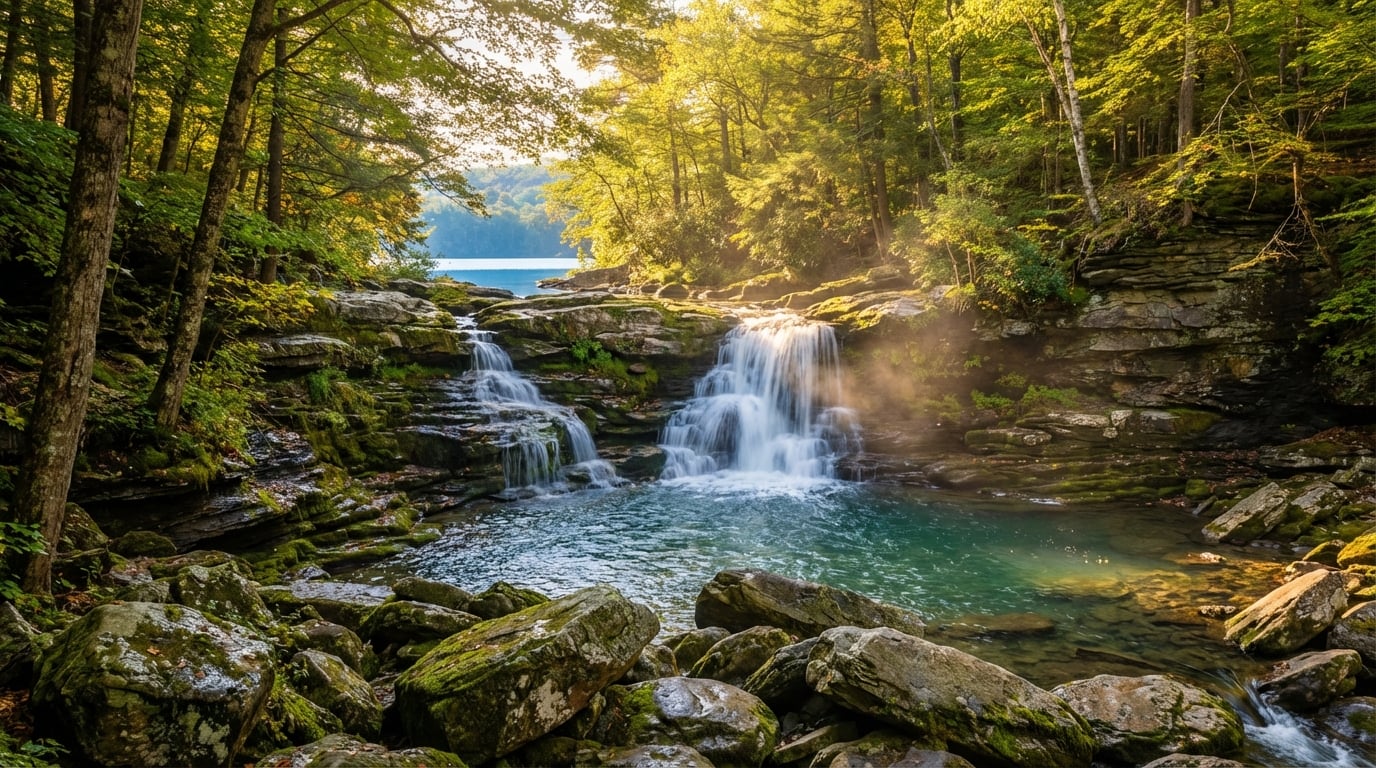

New York State has officially named its newest park on Cayuga Lake’s western shore Three Falls State Park, a designation that honors the trio of scenic waterfalls on and adjacent to the 90-acre property. The New York State Office of Parks, Recreation and Historic Preservation announced the name Monday, unveiling a conceptual development plan for the site that was formerly known as Camp Barton, a property operated for decades by the Boy Scouts of America’s Baden-Powell Council before the state acquired it in 2025. The park sits just north of Taughannock Falls State Park and features approximately half a mile of Cayuga Lake shoreline along with the 128-foot Frontenac Falls, formed where Trumansburg Creek cascades through the landscape.
The property’s transformation from scout camp to state park represents a rare opportunity to preserve valuable waterfront land while expanding public access to one of the Finger Lakes’ most picturesque corridors. The creek that shaped the waterfalls inspiring the park’s name flows through three municipalities—the Village of Trumansburg and the towns of Ulysses and Covert—creating a natural connection among communities that will now share in the park’s governance.
Three Falls State Park will be managed and operated by the Three Falls Local Development Corporation, a collaborative partnership involving the Village of Trumansburg and the towns of Ulysses and Covert, according to Finger Lakes Daily News. The development corporation will oversee future programming and events at the park, creating a governance model that differs from traditional state park administration.
Acting Commissioner Kathy Moser of the New York State Office of Parks, Recreation and Historic Preservation emphasized the collaborative nature of the project in her announcement. “Through important partnerships like this, we’re advancing Governor Hochul’s vision to encourage New Yorkers and visitors to ‘Get Offline and Get Outside,’ making it easier for them to stay active and connect with nature,” Moser said.
The local development corporation model differs from traditional state park administration structures. Concession opportunities, guided tours, and vendor contracts within state park boundaries are awarded through competitive public bidding and Request for Proposals processes.
State and local officials released a conceptual development plan alongside the naming announcement, outlining phased improvements designed to balance recreation with environmental sustainability. A draft plan is now available for public review, detailing a vision that includes restoring former scout camp cabins, constructing new docks and kayak launches, and developing additional hiking trails and waterfall viewing areas.
The plan also calls for creating a nature center and environmental education space, installing a permanent parking area with more than 110 spaces, and modernizing restroom and event facilities. Many upgrades would repurpose existing buildings and infrastructure from Camp Barton while improving accessibility and sustainability across the property, according to officials who detailed the park’s future.
The emphasis on kayak launches, hiking trails, and waterfall viewing suggests the park will attract day-use visitors and short-stay campers seeking outdoor recreation opportunities along Cayuga Lake. The parking area of more than 110 spaces reflects the park’s planned capacity for visitors exploring the property’s natural features.
Environmental preservation emerges as a major focus of the development plan. State officials have outlined specific conservation measures including protecting peregrine falcon nesting areas near the gorge along Trumansburg Creek, removing invasive plants such as Japanese knotweed, and limiting human activity in sensitive woodland areas near the gorge.
These efforts will help preserve one of the Finger Lakes region’s unique natural landscapes while establishing the park’s identity as an ecologically responsible destination. The Japanese knotweed removal effort addresses a regional invasive species challenge affecting properties throughout the Finger Lakes corridor.
The planned nature center and environmental education space signals the region will attract guests with strong ecology and conservation interests. The facility will provide educational programming focused on the natural features that define the park, including its signature waterfalls and the gorge ecosystem along Trumansburg Creek.
Improvements at Three Falls State Park will be completed in phases as funding becomes available. Funding is expected from a combination of state allocations, grants, and community partnerships, reflecting a collaborative approach that local leaders have described as a rare opportunity to preserve waterfront land and expand public access to Cayuga Lake.
Three Falls State Park will become the Finger Lakes region’s newest state park once development progresses, offering expanded recreation and educational opportunities while preserving valuable Cayuga Lake waterfront for public access.
