

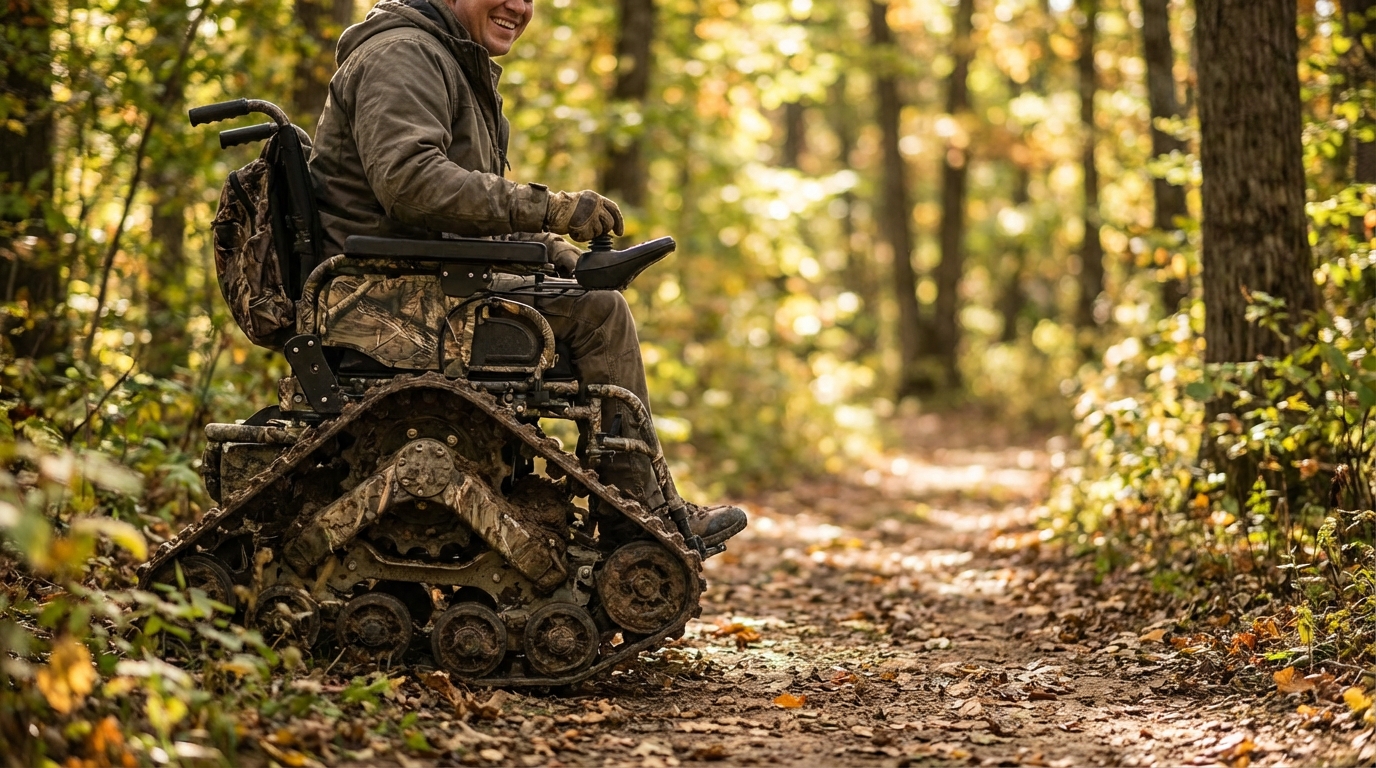

The Indiana Department of Natural Resources announced the deployment of 45 all-terrain track chairs across all 37 state parks, recreation areas and state park inns, positioning Indiana as the national leader in track chair availability among state park systems, according to the Indiana Capital Chronicle. The equipment, which will be available free of charge to visitors with mobility challenges, was unveiled at a media event Tuesday, March 17, 2026, at Fort Harrison State Park in Indianapolis, where officials and disability advocates gathered to demonstrate the technology that allows users to navigate rugged off-road environments including dirt trails, sand, snow and uneven ground. The initiative supplements approximately a dozen powered mobility chairs already in use at select properties, most of which were acquired through donations and “friends of” groups.
“Through surveys, our guests tell us that hiking is the most popular park activity, but unfortunately, our friends with mobility limitations frequently cannot experience the joys of our amazing trails,” said Alan Morrison, director of the Indiana Department of Natural Resources. Morrison noted the track chairs allow Hoosiers with mobility limitations “to explore off-road, rugged environments.”
Indiana’s initiative provides one potential model for the private sector. For private campground and RV park operators, accessibility investments deliver measurable returns beyond regulatory compliance. Properties offering adaptive equipment typically experience expanded market reach by welcoming guests who might otherwise be unable to visit. The aging Baby Boomer population represents a significant and growing demographic with both disposable income and increasing mobility needs, making accessibility a strategic business consideration rather than simply a compliance checkbox. Many private operators find that shared-use equipment models work effectively, where one or two devices serve an entire property rather than requiring individual unit modifications.
The Axis model track chairs from ATX Manufacturing feature tank-like treads mounted on tracks from a snowmobile manufacturer instead of standard wheels. Each unit weighs approximately 450 pounds for added traction and stability, with battery charges lasting up to eight hours on a single charge. The devices can accommodate users from small child size to full-grown adult and include six adjustment points: armrests adjustable for arm length, torso width and core functioning; an adjustable footrest; and controls that can be moved for right- or left-handed driving. Outdoor accessories include fishing rod holders and firearm holders, while hour meters track usage. Officials estimate a 20-year lifespan for each device.
The DNR used approximately $1 million from a Lilly Endowment Inc. grant to purchase the 45 track chairs and portable generators, costing about $22,000 per set. This funding is part of a broader $50 million grant awarded to the department in 2024 for park upgrades, with ongoing track chair maintenance coming from DNR operating funds.
While state agencies can leverage large grants for accessibility initiatives, private campground and RV park operators have their own expanding range of financing options. Some equipment manufacturers offer lease-to-own arrangements, and various state and federal programs provide grants or tax incentives for accessibility upgrades at commercial recreation facilities. Operators should weigh upfront equipment costs against potential increased bookings, extended shoulder season visits and positive reputation benefits. Insurance considerations are generally manageable when operators implement standard protocols, and most commercial recreation insurance providers are familiar with adaptive equipment coverage.
Jeremy Warriner, founder of disability advocacy group Walking Spirit who became a double amputee after a flaming vehicle wreck in 2005, completed a ceremonial first ride during the media event held outside The Garrison Conference Center at Fort Harrison State Park. Minutes before launching himself up a hill during the demonstration, Warriner exclaimed, “It turns on a dime!” Speaking to reporters afterward, Warriner reflected on his journey: “Before I lost my legs … I was a backpacker. I have a family that loves to get out into nature.” He continued, “… Many of us tell ourselves these lies when we acquire disabilities, that we’re not going to be able to do those things again.” Warriner added, “But as technology improves … all of these things open back up.”
Indiana’s inclusion of advocate Jeremy Warriner at the public demonstration illustrates the power of authentic representation in promoting accessible programs—a principle private operators can apply through their own partnerships and guest testimonials.
Ric Edwards, ADA compliance director for Indiana DNR who led the initiative, shared his personal connection to the program. “I grew up in Spencer, Indiana, visiting McCormick’s Creek State Park and going in creeks and woods until a car accident caused me to have to use this wheelchair,” Edwards said. “I believed, wrongly, that those days were over. … People like me and my family, my friends and some that we will never know, will be able to experience nature in a way not previously possible.”
The track chairs will be available free of charge to all park visitors, who can call a state park office to get on a list ahead of time or sign up day-of at the office on a first-come, first-served basis. The DNR hopes to roll out an online reservation system within a few months. To use the chairs, visitors or legal guardians must sign a user agreement, provide a major credit card or state-issued ID as security, and receive basic operational training from park staff. Users 16 or younger must be accompanied by an adult. “The charge lasts up to eight hours. So, if we don’t have anyone that’s waiting on it, you would be welcome to take it out for that entire time frame,” explained Brandt Baughman, Indiana State Parks director.
The DNR will designate defined areas for track chair use at each property, with Baughman explaining these areas will have “no terrain issues, no ruts, or anything that would be dangerous for them.” Staff will monitor usage times to check on users, particularly in low-reception areas. Regarding monitoring users in remote locations, Baughman said, “we’ll probably have an idea of where they’re at and if they’ve been out for a while.”
Indiana’s approach of requiring signed user agreements, operational training, designated use areas and ID as security provides a practical template private operators can adapt. Campground and RV park owners can reference these established procedures when developing their own equipment loan policies, potentially reducing uncertainty that delays accessibility investments.
For private campground and RV park operators considering similar programs, properties that invest in accessibility often underutilize these features in marketing. Effective promotion emphasizes independence, adventure and inclusion rather than focusing solely on accommodation. Best practices include featuring accessible amenities prominently on websites rather than burying them in FAQ sections and incorporating images of guests using adaptive equipment in natural settings. Staff training represents a frequently overlooked component—front-line employees who can confidently discuss equipment options enhance guest satisfaction. Partnerships with disability advocacy organizations, adaptive sports groups and rehabilitation facilities can create referral pathways that consistently drive qualified bookings.
The first 22 track chairs arrived the week prior to the March 17 announcement, with the remaining 23 distributed that Tuesday. No single date was announced for when all machines will be available at all parks. “We’ve had a few of these out in our system for several years now, and they just get a great amount of use,” Baughman said, recalling his time managing Indiana Dunes State Park.
The track chair initiative is part of broader DNR accessibility efforts that include beach mats for easier water access, fishing piers with ramps and lower railings, wheelchair-accessible hunting paths and blinds, and special viewing stations. With Indiana now claiming national leadership in state park track chair availability and an online reservation system expected within months, the program is designed to ensure visitors with mobility challenges can access trails and outdoor experiences previously unavailable to them.
