
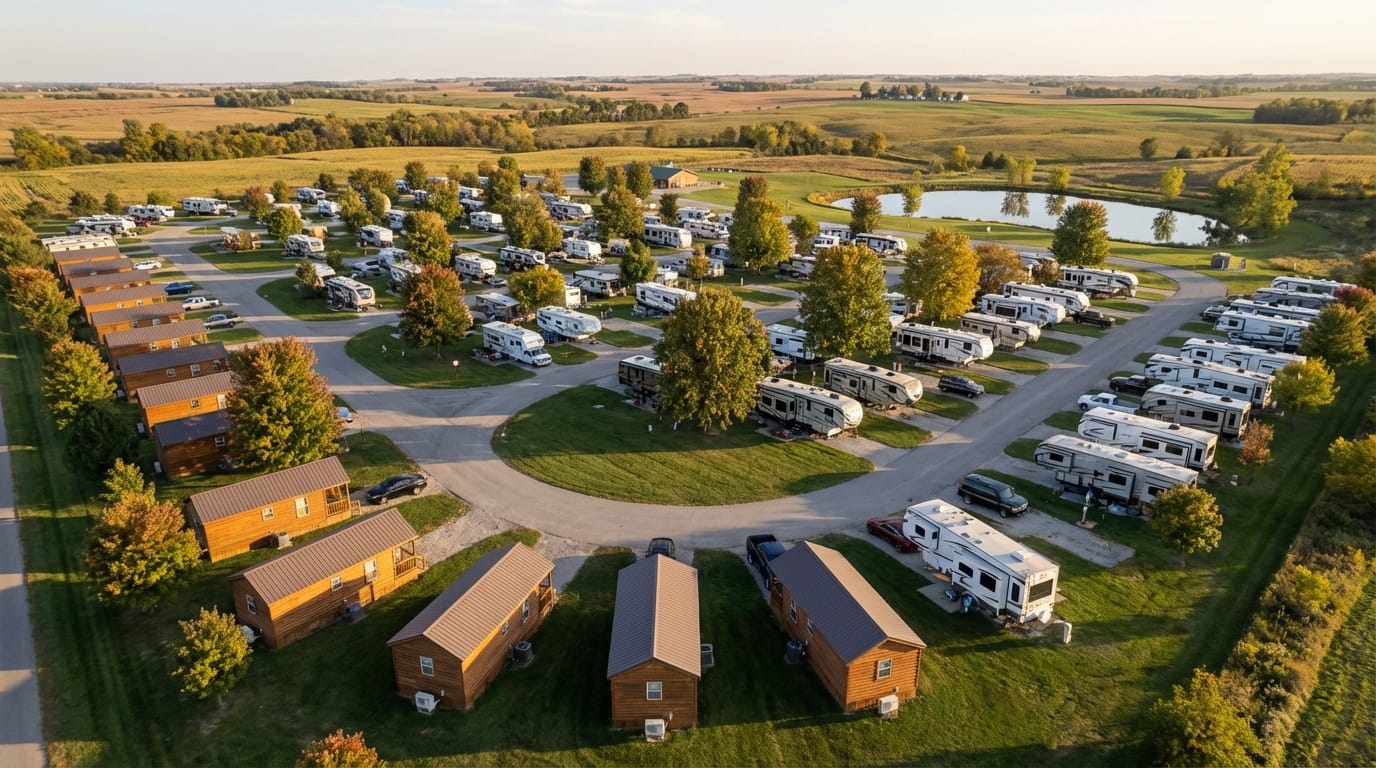

The summer of 2026 has brought a stark wake-up call for the outdoor hospitality industry. Private campground owners are navigating the steepest demand contraction in years.
As Brian Searl, gazda MC Fireside Chats, observed during a May panel: “This summer is going to be, let’s call it challenging for some of the transient parks in our industry.”
The strategy that carried parks through previous downturns — rate cuts and broad-reach marketing — is no longer enough.
Modern camper behavior has fundamentally shifted. Rather than planning extended road trips far from home, many families are traveling shorter distances, taking shorter vacations and making reservations closer to their departure dates. This trend is reflected in Datele 2026 showing that about one in four campers now books less than a week before their trip, while nearly 40% expect to shorten their booking window even further.
Cara Csizmadia, president of the Asociația canadiană de camping și RV (CCRVA), noted that these macro-economic pressures are trickling down heavily into everyday operations. “A family that used to stay for seven days might only stay for four now,” Csizmadia explained.
To stay competitive, private campgrounds need to optimize for AI-driven search and lean into hyper-local marketing. “Those impacts are going to compound and certainly be felt this summer,” Csizmadia added.
Navigating the Agentic Booking Age
Compounding this economic strain is a quiet revolution in how travelers discover destinations. According to the discussion, Google recently disrupted 25 years of search tradition by pushing its text-expanding, conversational “AI Mode” to the forefront of search results. The era of a traveler typing “campgrounds near me” and scrolling through static blue links is rapidly evaporating.
Instead, consumers are letting Google’s native AI do the heavy lifting, using conversational sentences that dictate highly specific preferences, multi-step parameters, and real-time logistical needs. Operators are now competing in what’s being called an agentic booking environment — where AI handles the search and surfaces only the best matches.”
Today’s traveler types commands like, “Find me a pet-friendly campground within 150 miles of St. Louis that has 50-amp full hookups and an available deluxe cabin for Labor Day weekend.” As Amber Simpson, founder and lead strategist at MartrekDigital, emphasizes: “Google is going to find it and pull it in there and they book. And if you’re not optimized to show up for that, they’re never going to make it to your website.”
Unfortunately, a gap exists between this technological shift and the day-to-day reality of independent operators. For decades, software adoption in the outdoor hospitality space was built on a passive mindset: wait for software providers to release a feature, then figure out how to use it. Searl argues that this approach is backwards.
“The disconnect really is people are waiting for ChatGPT or Claude to be this thing that does all the stuff for them… That’s not the best use of AI,” Searl stated. “The best use of AI, in my opinion, is you got to use AI to build the tool that’s custom to your company.”
Echoing the massive gap in day-to-day operations, campers are becoming increasingly comfortable with artificial intelligence as a trip-planning tool, though widespread adoption has yet to follow, according to Raportul de camping din 2026 al lui Dyrt. The report also found that 33.6% of campers trust AI to recommend a campground.
Despite that trust, only 10.3% of respondents said they have used AI to plan a camping trip, while another 9.7% indicated they intend to use AI for trip planning in 2026, suggesting significant room for future growth as awareness and familiarity with AI-powered tools continue to expand.
“The fact that a third of campers say they trust AI to plan a camping trip, but only a tenth have actually done so, shows huge growth potential in the market for camping tech and tools,” Kevin Long, CEO of The Dyrt, said in a press release.
Defining Your “Difference Makers”
Before optimizing for AI search, operators need to identify what actually sets their property apart. Many parks built during the boom years of the late 20th century resemble identical, paved parking lot layouts.
To unearth these subtle differentiators, operators can copy their website’s raw content and source code and dump it directly into an advanced large language model. By asking the AI to audit the site from the perspective of an independent third party, owners can uncover hidden experiential strengths or glaring content gaps.
Simpson highlights that the foundational storytelling element is frequently missing from digital listings. “I’ve seen a lot of these about us pages and it’s a Google map and a contact us form,” Simpson observed
However, as tech adoption accelerates, operators must tread carefully to avoid the dangerous trap of synthetic deception. In an industry deeply rooted in nature and authentic human connection, today’s environmentally and socially conscious campers display a fierce intolerance for obvious AI-generated content.
Recent tourism behavior research by Marlina (2025) confirms that Gen Z and Millennial travelers are driven by a strict “eco-experiential orientation,” actively favoring nature-connected authenticity over sanitized, predictable environments.
Csizmadia noted that she has “already received feedback from consumers who are a bit put off by campgrounds who are obviously using AI tools.”
Simpson issues a warning against this form of digital fabrication. “I worry about some of the ways that our owners are using it incorrectly to save time and money, but it’s actually hurting them in the long run,” Simpson stated.
“The example I use time and time again is don’t use AI images of your campground that are not real. It’s way better to just use a semi-crappy smartphone image than it is to have a completely AI-generated one,” Simpson added.
Going Hyper-Local
While adjusting the digital engine under the hood is critical for long-term visibility, mitigating the immediate 2026 transient slump requires a drastic shift in geographic targeting. Digital marketing agencies are universally counseling parks to shrink their traditional 300-mile geofencing radiuses down to a strict 150-mile parameter.
Because travelers are intensely price-sensitive regarding fuel and food costs, the most reachable guests for the rest of 2026 live within about two hours of the property “We are going hyper-local, we are really leaning into Google Business Profile and optimization there, that is number one,” Simpson advises.
This hyper-local pivot means putting an unprecedented amount of energy into optimizing a park’s Google Business Profile. This profile is no longer a static digital yellow-pages listing; it must be updated weekly with real-time photos, community announcements, and localized posts.
When localized data is fresh, Google’s conversational search algorithms prioritize the property for regional weekend warriors looking for a quick, close-to-home escape.
The challenging landscape of 2026 is ultimately separating the adaptive operators from the static ones. The private campgrounds that thrive through this transition will be those that view technological disruption and economic hardship not as crippling barriers, but as a mandate to innovate.
As Csizmadia concludes, the initial onboarding of these advanced digital workflows can feel daunting, but it remains an operational necessity.
“We often talk about like great experiences and all these things that the guest is demanding, and then at the same time affordability,” Csizmadia reflected. “Oftentimes it can be incredibly daunting to think about having to handle both those things simultaneously. And I think AI is probably the key to being able to do that.”
Despre noi MC Fireside Chats
MC Fireside Chats este o experiență de podcast live dedicată industriei ospitalității în aer liber și recreerii în aer liber. Găzduit de Brian Searl, fondator și CEO al Insider Perks și Modern Campground, spectacolul oferă discuții captivante cu lideri ai industriei, inovatori și experți care modelează viitorul campingului, rulourilor în rulotă, glampingului și recreerii în aer liber.
Difuzată în fiecare miercuri la ora 14:00 (ET), emisiunea urmează o temă săptămânală structurată pentru a oferi analize aprofundate ale celor mai relevante subiecte:
- Săptămâna 1: Tendințe și perspective în industrie
- Săptămâna 2: Îmbunătățirea experienței oaspeților
- Săptămâna 3: Operațiuni și management de afaceri
- Săptămâna 4: Marketing, Inteligență Artificială și Tehnologie
Fiecare episod prezintă un grup de oaspeți recurenți, completat de 1-2 invitați speciali rotativi, inclusiv analiști din industrie, proprietari de campinguri, furnizori de tehnologie, susținători ai sustenabilității și multe altele. Indiferent dacă explorați cele mai recente tendințe ale pieței sau strategii inovatoare pentru experiența oaspeților, MC Fireside Chats oferă informații care provoacă gândirea profesioniștilor și entuziaștilor din spectrul de recreere în aer liber.
Pentru a explora episoadele anterioare ale MC Fireside Chats, Vizitați: moderncampground.com/mc-fireside-chats.