

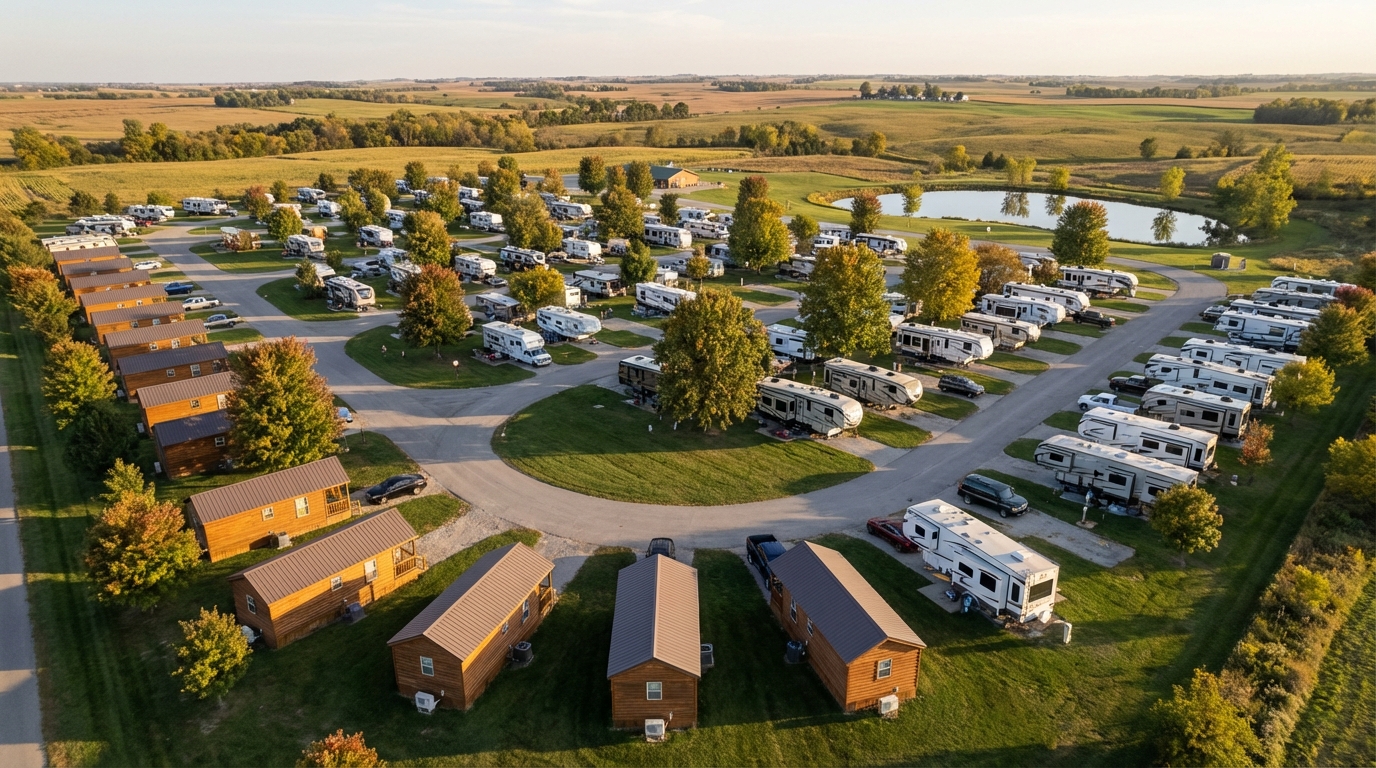

The Village of Oswego and United City of Yorkville are approaching final approval on a 20-year jurisdictional boundary agreement that resolves long-standing questions surrounding Fox Bluff Vacation Cottage and RV Resort, a 151-acre property at 8045 Van Emmon Road near Illinois Route 71. Oswego approved the agreement on Jan. 6, 2026, placing the resort firmly within its jurisdiction, while Yorkville is advancing ratification through March with a public hearing tentatively scheduled for March 10 and a final vote expected at the March 24 City Council meeting.
For RV park and resort owners, understanding municipal jurisdiction is a fundamental component of operational planning and due diligence before any property acquisition. Properties located near municipal boundaries or in unincorporated areas often face ambiguity regarding which government entity provides essential services, enforces zoning codes, and collects taxes. Experienced operators know that clear jurisdictional status simplifies insurance underwriting, lending processes, and resale valuations, as lenders and insurers prefer properties with straightforward municipal relationships because ambiguity introduces risk factors that are difficult to quantify.
The Fox Bluff property carries a complex history that made it a focal point of negotiations between the two municipalities. Property owner Lance Beatch purchased the site in December 2020 and redeveloped the former Hide-A-Way Lakes campground, with Oswego voting to annex the resort in April 2022. Yorkville city staff described the resort as “one of the primary outstanding issues that previously delayed” a long-term jurisdictional boundary agreement, according to reporting from Shaw Local. The two communities had maintained a boundary agreement since 2001 that expired in September 2021, which previously governed overlapping planning jurisdictions within 1.5 miles of each community’s municipal limits.
The confusion surrounding police services at the resort illustrates precisely why unclear boundaries create operational challenges for outdoor hospitality properties. Since Oswego’s 2022 annexation of the resort, the Yorkville Police Department continued responding to calls at the property, logging four calls for service at Fox Bluff between April 2023 and December 2025. According to city documents, the new agreement must clarify primary police response responsibilities, with the recent calls demonstrating the continued practical need for cooperative response protocols. Under the new agreement terms, Oswego is explicitly assigned primary police response duties.
The Fox Bluff situation underscores best practices that operators should follow when evaluating properties with jurisdictional complexities. Before any purchase, operators should verify which municipality holds planning and zoning authority, as this determination shapes permitting processes, allowed land uses, and future expansion possibilities. Equally important is obtaining written confirmation of which agencies provide police, fire, and emergency medical services, since response times and service quality can vary significantly between jurisdictions. Operators should also review any existing boundary agreements or annexation petitions that could affect a property within the investment horizon. Properties located in self-determination zones deserve particular scrutiny, as they may face competing regulations or uncertain service delivery that complicates long-term planning.
A key structural change in the new agreement involves the elimination of self-determination zones that existed within the shared planning boundary. These zones previously allowed property owners to choose which municipality they wished to annex to, introducing uncertainty into long-term planning. Barksdale-Noble explained in city documents that “these areas previously allowed landowners to petition for annexation to either municipality, which introduced long-term uncertainty and the potential for annexation disputes.” The removal establishes fixed boundary lines to guide future growth and service delivery, limiting landowner flexibility but eliminating long-term ambiguity.
Annexation can change tax structures, utility rates, and compliance requirements, sometimes substantially affecting operating costs for resort properties. Outdoor hospitality operators and investors should recognize that properties with straightforward municipal relationships generally command better valuations and face fewer complications during financing and insurance processes. The Fox Bluff agreement demonstrates how municipalities and property owners can work toward resolving these ambiguities through formal boundary accords.
The agreement also reflects water supply coordination between the municipalities, aligning future water planning for the resort with a joint Lake Michigan water sourcing project expected to bring lake water to both Oswego and Yorkville by 2028. This regional initiative has significant implications for outdoor hospitality properties, which often have substantial water demands based on their operational scope and amenity offerings.
Water availability and quality rank among the most important infrastructure considerations for outdoor hospitality properties. Adequate water supply directly affects guest capacity, amenity offerings, and regulatory compliance. Operators should calculate water demand based on full occupancy plus peak usage periods, accounting for RV hookups, bathhouses, laundry facilities, pools, and irrigation needs. The choice between well water, municipal connections, and private water systems carries distinct implications for operations, with each option presenting different maintenance requirements, testing obligations, and per-unit costs that affect long-term budgeting. When assessing any water source, operators must evaluate both current capacity and future expansion potential, recognizing that adding sites or amenities typically requires proportional increases in supply. Planning for redundancy where possible protects against water system failures that can force temporary closures and create significant liability exposure.
The trend toward premium amenities at RV resorts and glamping properties has increased water demands across the industry. Features such as splash pads, expanded pool complexes, dog washing stations, and landscaped common areas all require reliable high-volume water access. Properties connected to municipal systems with long-term supply agreements generally have advantages when planning these upgrades compared to those relying solely on wells or private systems. Properties with combined vacation cottage and RV resort formats typically have substantial water demands, making coordination with regional water infrastructure particularly relevant for sites like Fox Bluff. Participation in regional water initiatives, even indirectly through municipal partnerships, can enhance property values and operational stability over multi-decade investment horizons.
The new boundary agreement runs for 20 years, set to expire Feb. 1, 2042. Yorkville city staff supports the agreement because it “reduces annexation conflicts, supports orderly development, and promotes regional coordination.” The timeline for final approval includes the March 10 public hearing followed by the expected final vote on March 24.
Once Yorkville completes its ratification, Fox Bluff Vacation Cottage and RV Resort will operate under clear jurisdictional guidelines for the next two decades. The resolution of this boundary dispute provides a model for how municipalities and property owners can address jurisdictional ambiguities that affect service delivery, planning authority, and operational certainty. For outdoor hospitality operators considering properties near municipal boundaries, the Fox Bluff case underscores the importance of thoroughly investigating jurisdictional status during due diligence, confirming service responsibilities in writing, and understanding how regional infrastructure initiatives may affect long-term property value and operational capacity.
